Which Air Dryer Is Best for CNC Machines? Refrigerated vs Desiccant Air Dryer
Quick Answer:
A refrigerated air dryer is the right fit for most general-purpose CNC shops running in stable indoor conditions, since it reliably reaches a dew point around 35°F–40°F at lower cost and easier upkeep. A desiccant (heatless) air dryer is the better choice when your CNC line needs a much lower dew point, precision or aerospace-grade machining, humid or coastal facilities, cold or unheated workshop areas, or pneumatic tool changers and spindle air seals that can't tolerate any residual moisture.
Why Compressed Air Quality Matters for CNC Machines
CNC machines depend on clean, dry compressed air for far more than just blowing away chips. Pneumatic tool changers, spindle air-seal purges, hydraulic clamping circuits, and probing systems all run on the same air supply, and every one of them is sensitive to moisture in a way that general shop air tools are not.
When water vapour makes it past an undersized or poorly matched dryer, it condenses inside pneumatic lines and solenoid valves, causing sticking, slow tool-change cycles, and eventual valve failure. Inside the machine itself, moisture can corrode precision ways, ball screws, and linear guides, surfaces where even light surface rust translates directly into lost accuracy. Air-blast and coolant-through-spindle systems can also pick up contamination, affecting both part finish and tool life.
Because CNC tolerances are tighter and the components more sensitive than in a typical air-tool application, the dryer feeding a CNC line generally needs to hold a more consistent, lower dew point than a general-purpose pneumatic system would require.
Read More: Air Compressor Parts Explained: Names, Functions & Maintenance
What Dew Point Does a CNC Machine Actually Need?
Dew point is the temperature at which moisture in compressed air starts to condense back into liquid. The lower the dew point, the drier and safer the air. For CNC applications, the right dew point depends heavily on your shop environment and how sensitive your specific setup is to residual moisture:
|
CNC Shop Environment |
Typical Dew Point Need |
Suggested Dryer Type |
|
General indoor machining, stable climate |
35°F–40°F (2°C–4°C) |
Refrigerated |
|
Humid, coastal, or seasonal-humidity regions |
Below freezing (0°C or lower) |
Desiccant |
|
Precision/aerospace-grade or metrology-adjacent work |
-40°C or lower |
Desiccant |
|
Unheated or outdoor-adjacent pneumatic lines |
-40°C or lower (freeze protection) |
Desiccant |
As a general guide: a refrigerated dryer holding a dew point in the 35°F–40°F range is adequate for most indoor, climate-stable machining environments. Once you're dealing with humidity swings, unheated spaces, or precision work where even trace moisture is a risk, a desiccant system capable of -40°C or lower becomes the safer standard.
Read More: Air Compressor Maintenance Guide | Checklist & Service Tips 2026
Refrigerated Air Dryers for CNC — How They Work and When They Fit
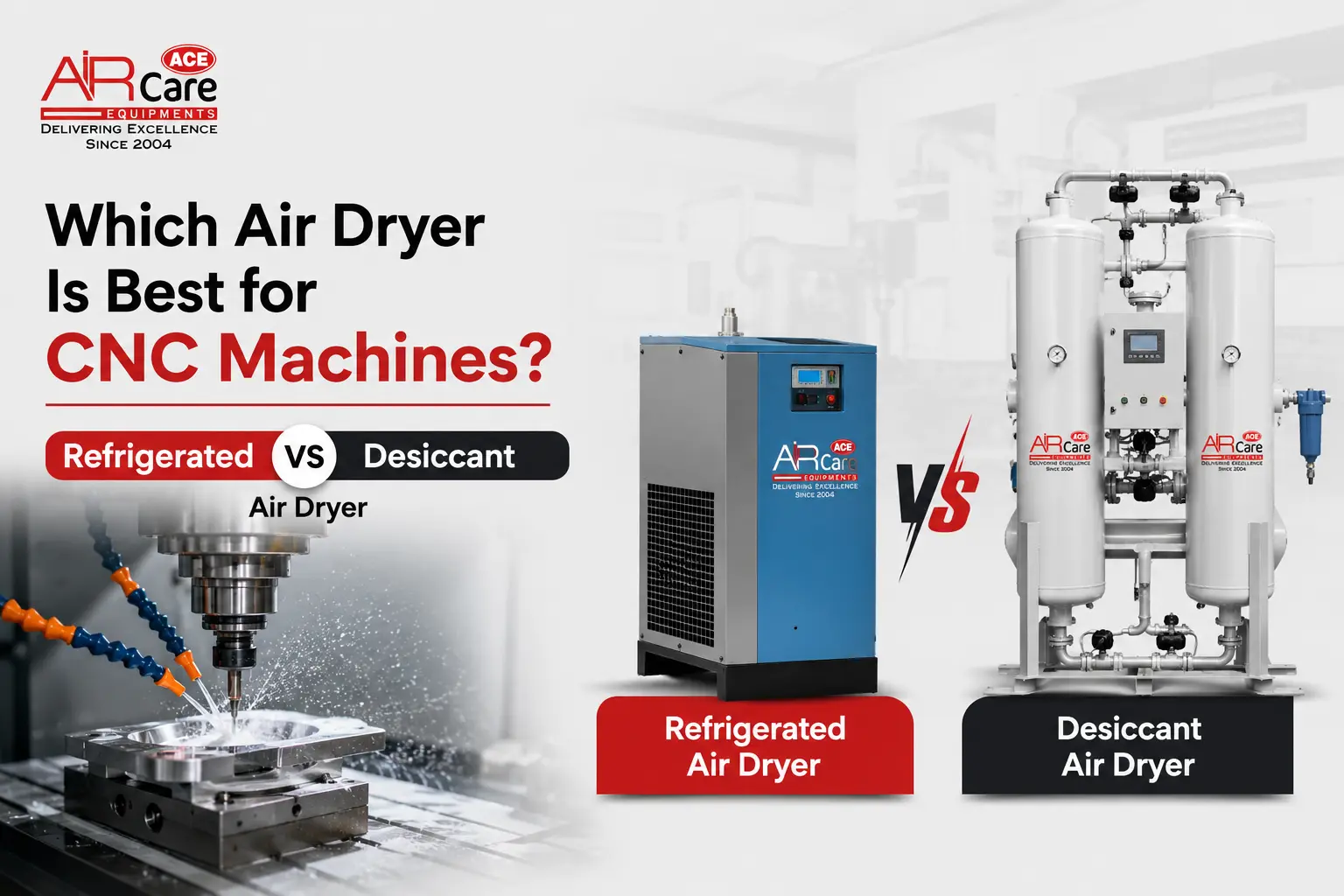
A refrigerated air dryer cools incoming compressed air to a low temperature, typically around 37°F (3°C), so that water vapour condenses out and is captured by a separator before being automatically drained. The air is then reheated slightly and sent downstream, dry and ready to use.
For CNC applications, refrigerated dryers are a strong fit when:
- The shop runs a general-purpose machining operation with stable indoor temperature and humidity
- Pneumatic demands are for tool changes, chip-blow, and standard clamping, not ultra-precision or clean-room-adjacent work
- Budget and maintenance simplicity matter alongside performance
Advantages include lower upfront cost, straightforward operation, and energy-efficient cycling technology that only draws significant power when air is actually being demanded. The trade-off is a dew point floor of roughly 35°F–40°F, sufficient for most machining floors, but not low enough for freezing environments or applications where zero residual moisture is non-negotiable.
Also Read: Air Compressor Sizing Guide: Calculating CFM & PSI for Air Tools
Desiccant (Heatless) Air Dryers for CNC, How They Work and When They Fit
A desiccant air dryer, often called a heatless air dryer, uses a bed of adsorbent material, such as activated alumina or molecular sieves, to pull moisture directly out of the air stream rather than condensing it out with cold. The system runs two towers on a Pressure Swing Adsorption (PSA) cycle: while one tower actively dries the air, the other regenerates using a small portion (typically 10–15%) of the already-dried air, switching roles every 5–10 minutes for a continuous, uninterrupted supply of dry air.
For CNC applications, desiccant dryers are the better choice when:
- The line feeds precision or aerospace-grade machining where even a trace of moisture risks part quality or equipment integrity
- The facility is in a humid or coastal region, or ambient conditions swing seasonally
- Pneumatic lines run through unheated areas or anywhere freezing is a risk
- The CNC line sits alongside processes — paint, inspection, cleanroom — that already demand ultra-dry air
These systems reach dew points as low as -40°C (-40°F), and specialised units go down to -70°C (-94°F), far beyond what a refrigerated system can achieve. The trade-off is higher upfront and running cost, small 20–50 CFM units typically run ₹30,000–₹75,000, with larger industrial systems ranging from ₹1.5 lakh to ₹5 lakh or more, plus periodic desiccant replacement, generally every 2–3 years depending on air quality and oil carryover.
Read More: Single-Stage vs Two-Stage Air Compressor: Which Is Better for Industrial Use?
Refrigerated vs Desiccant Air Dryer for CNC — Comparison Table
|
Factor |
Refrigerated Air Dryer |
Desiccant (Heatless) Air Dryer |
|
Achievable dew point |
Around 37°F / 3°C (typical 35°F–40°F) |
-40°C (-40°F), or -70°C (-94°F) for critical use |
|
Working principle |
Cools air to condense and drain moisture |
Twin-tower desiccant beds adsorb moisture (PSA cycle) |
|
Upfront cost |
Lower |
Higher, roughly ₹30,000–₹75,000 for 20–50 CFM units, ₹1.5L–₹5L+ for larger industrial systems |
|
Running cost / energy use |
Lower — cycling designs draw power only on demand |
Higher — regeneration consumes 10–15% of dried air |
|
Maintenance |
Check drain daily, clean condenser coils monthly, annual service |
Minimal moving parts; desiccant typically replaced every 2–3 years |
|
Best CNC use case |
General-purpose indoor machining, moderate-humidity shops |
Precision/aerospace-grade machining, humid or coastal facilities, cold environments |
|
Cold-weather performance |
Can struggle or freeze in very low ambient temperatures |
Reliable even in freezing conditions |
How to Choose the Right Air Dryer for Your CNC Setup
Run through these questions before deciding:
- What's your shop's ambient humidity and temperature? Does it stay stable indoors or swing with the seasons?
- Is your CNC line adjacent to processes that already need ultra-dry air, like paint booths or inspection rooms?
- What CFM does your compressor and CNC pneumatic system draw, and does your current dryer match that demand?
- How much ongoing maintenance capacity and budget do you realistically have?
- Are any of your pneumatic lines exposed to cold, unheated, or outdoor-adjacent areas?
If your answers point to a stable indoor environment with general-purpose machining needs, a refrigerated dryer, such as Air Care Equipment's RAD Series, available across a 20–1500 CFM range — will typically deliver reliable protection at the lowest total cost. If precision, humidity, or cold-weather risk are part of the picture, a heatless desiccant dryer is the more dependable long-term choice.
Also Read: Air Dryer for Pharmaceutical Manufacturing: Types, Benefits & Guide (2026)
Conclusion
There's no universal 'best' air dryer for CNC machines—the right choice comes down to how sensitive your line is to moisture and what your shop environment demands. A refrigerated air dryer covers the vast majority of general-purpose CNC operations reliably and affordably, holding a dew point that protects tool changers, clamping systems, and machine surfaces without a heavy maintenance load. A desiccant (heatless) dryer earns its place when precision tolerances, humid or coastal conditions, or cold environments push your dew point requirements well below what a refrigerated system can hold.
Getting this decision right protects far more than the dryer itself — it protects tool life, part accuracy, and machine uptime. Air Care Equipment manufactures both refrigerated (RAD Series, 20–1500 CFM) and heatless desiccant air dryers, and can help size the right system to your CNC line's actual air demand and environment.
Frequently Asked Questions
Q1: What dew point is needed for CNC machines?
It depends on the application. Most general-purpose CNC shops in stable indoor conditions do well with a refrigerated dryer holding 35°F–40°F. Precision work, humid climates, or cold environments call for a desiccant dryer reaching -40°C or lower.
Q2: Can a refrigerated air dryer damage CNC precision components?
A properly sized refrigerated dryer won't damage components — the risk comes from undersizing or skipping a dryer altogether, which lets moisture reach pneumatic valves, tool changers, and machine surfaces. In environments where refrigerated dew points aren't low enough for the application, a desiccant system is the safer option.
Q3: Do desiccant dryers work better in cold workshop environments?
Yes. Desiccant (heatless) dryers are more reliable in freezing or near-freezing conditions, since refrigerated systems can struggle or freeze up when ambient temperatures drop very low.
Q4: How much CFM air dryer does a CNC machine need?
This depends on your compressor's output and how many pneumatic functions the CNC line runs simultaneously — tool changers, clamping, air blast, and so on. Sizing should be based on your actual peak air demand rather than the CNC machine alone; an undersized dryer won't hold its rated dew point under load.
Q5: Is a desiccant dryer overkill for a small CNC shop?
Not necessarily overkill, but often unnecessary. If your shop runs standard indoor machining without precision, cleanroom, or cold-weather demands, a refrigerated dryer is usually the more cost-effective choice. Desiccant systems earn their higher cost when the application genuinely needs an ultra-low dew point.
Recent Posts