Air Dryer for Pharmaceutical Manufacturing: Types, Benefits and Selection Guide
Pharmaceutical manufacturing uses compressed air for operating equipment, conveying materials, cleaning containers, coating tablets and supporting filling and packaging lines. Because atmospheric air contains water vapour, untreated compressed air can create condensation, corrosion and product-quality risks.
An air dryer for pharmaceutical manufacturing removes water vapour before compressed air reaches the production process. It helps maintain a controlled pressure dew point, prevents condensation and supports a cleaner, more reliable pharmaceutical compressed air system.
For critical applications, desiccant dryers are commonly preferred because they achieve lower pressure dew points. Refrigerated dryers suit general utility air, while hybrid systems combine dryness with improved efficiency.
Why Is an Air Dryer Required in Pharmaceutical Manufacturing?
An air dryer prevents water vapour from condensing inside compressed-air lines, where it can affect products, corrode pipelines and disrupt equipment.
The FDA identifies compressed air as a utility that may affect pharmaceutical product quality and states that such utilities should be qualified and appropriately monitored.
A pharmaceutical air dryer helps reduce the risk of:
-
Condensation in pipelines, receivers and filters
-
Corrosion and rust formation
-
Microbial growth in wet sections of the system
-
Damage to moisture-sensitive powders, tablets and capsules
-
Malfunctioning valves, actuators and filling equipment
-
Inconsistent air quality at the point of use
Drying does not make compressed air sterile, but it is essential to a complete air-treatment system.
Read More: Compressed Air Dryer Guide: Choosing the Right Technology for Your Industrial Needs
Where Is Compressed Air Used in Pharmaceutical Plants?
Compressed air is used in pharmaceutical facilities for:
-
Operating pneumatic valves and actuators
-
Conveying powders and granules
-
Tablet coating and drying
-
Capsule filling
-
Cleaning bottles, vials and containers
-
Aerating process vessels
-
Running filling and packaging machines
-
Purging process lines
-
Supporting laboratory and aseptic processes
The required air quality depends on how the air is used. Instrument air that only operates a cylinder does not necessarily require the same treatment as air that directly touches a product or primary packaging surface.
Read More: Top 10 Air Compressor Manufacturers in India (2026): Complete Buyer's Guide
Product-Contact vs Non-Product-Contact Compressed Air
Non-product-contact air operates equipment without touching the product. Indirect-contact air may touch packaging or machine surfaces that later contact it. Direct-contact air touches the product during conveying, drying, coating, filling or purging.
Direct-contact applications generally need tighter limits for particles, water, oil and microorganisms. Dryer selection should therefore reflect the risk at each point of use.
Which Air Dryer Is Best for the Pharmaceutical Industry?
A desiccant air dryer is commonly selected for critical pharmaceutical applications because it can produce very dry compressed air. However, the best air dryer for pharmaceutical industry operations depends on the required dew point, airflow, operating conditions and product-contact risk.
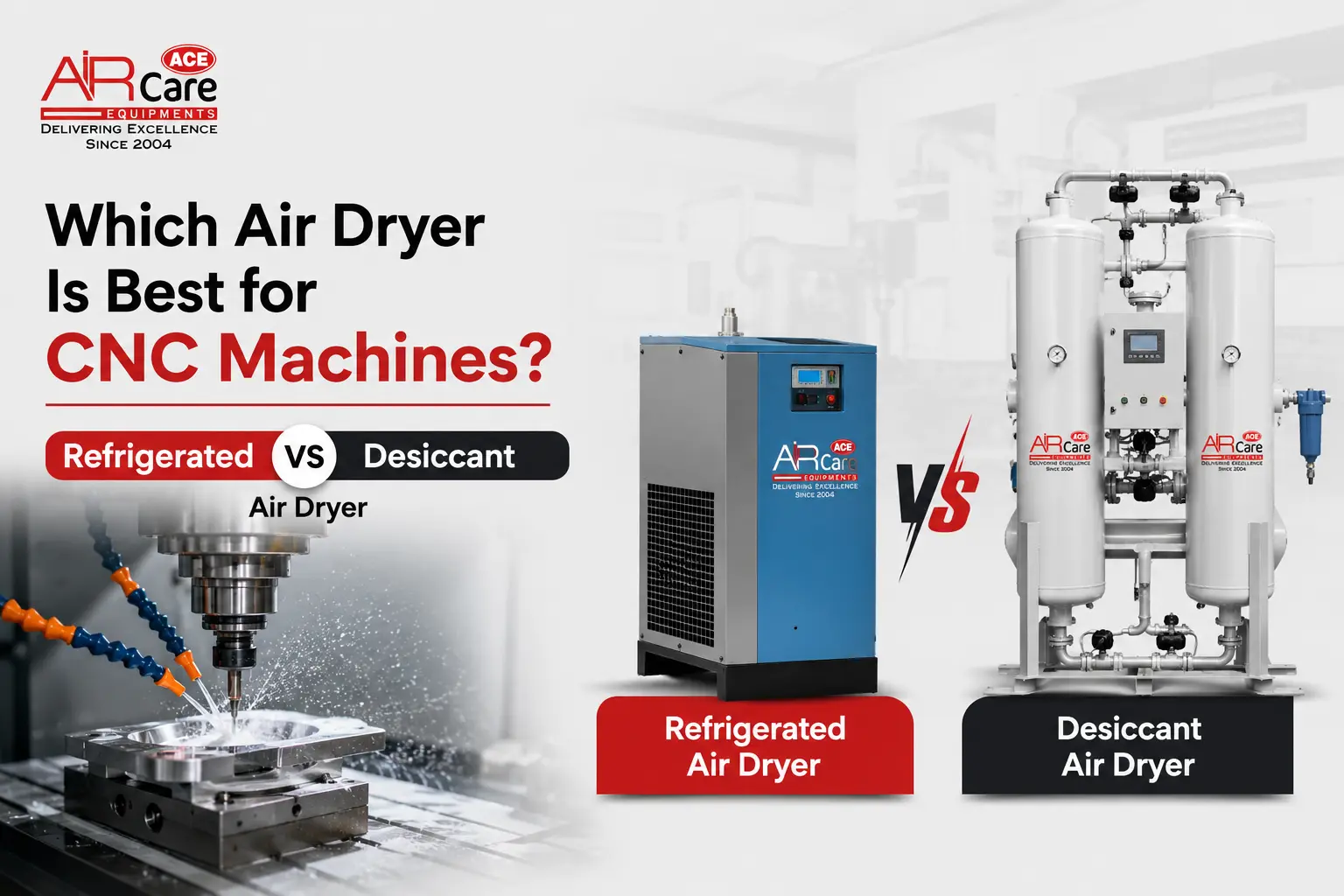
Refrigerated Air Dryer
A refrigerated air dryer cools compressed air until moisture condenses and is drained. It suits utility air, packaging machines and non-critical automation, but may not provide sufficiently dry air for hygroscopic products or critical contact processes.
Refrigerated dryers are generally preferred when:
-
Extremely low dew points are not required
-
The compressed air does not contact the product
-
The pipeline operates in a controlled environment
-
Energy efficiency is a priority
-
The air operates pneumatic tools or packaging machines
Desiccant Air Dryer
A desiccant dryer passes compressed air through moisture-adsorbing material such as activated alumina or silica gel. It can achieve a much lower pressure dew point than a conventional refrigerated dryer.
A desiccant air dryer for pharmaceutical industry applications is suitable when:
-
The product is highly moisture-sensitive
-
Compressed air directly contacts the product
-
Very low pressure dew points are required
-
Air lines may be exposed to low temperatures
-
Air is used for powder conveying or process drying
Air Care Equipment identifies desiccant dryers as one of the most commonly used dryer types in the pharmaceutical sector.
Also Read: Air Compressor Maintenance Guide: Complete Checklist to Maximize Performance & Lifespan
Hybrid Air Dryer
A hybrid system uses refrigerated and desiccant stages to achieve low dew points with lower regeneration demand. It can suit high-flow pharmaceutical plants.
The refrigerated stage removes a significant portion of the moisture before the compressed air enters the desiccant stage. This reduces the moisture load on the desiccant and can improve the overall energy performance of the system.
Pharmaceutical Air Dryer Comparison
|
Dryer type |
Best suited for |
Key benefit |
Main limitation |
|
Refrigerated |
Utility and non-critical pneumatic air |
Energy-efficient moisture removal |
Limited low-dew-point capability |
|
Desiccant |
Critical and moisture-sensitive processes |
Produces very dry air |
Higher operating requirements |
|
Hybrid |
Continuous high-flow applications |
Balances dryness and efficiency |
More complex system |
|
Membrane |
Small point-of-use requirements |
Compact design |
Purge-air loss |
What Is Pressure Dew Point?
Pressure dew point is the temperature at which water vapour begins to condense at the compressed air’s operating pressure. A lower pressure dew point means drier compressed air.
The dryer should maintain a dew point below the lowest temperature expected in the distribution network. The target should reflect product sensitivity, process temperature, pipeline location and the approved air-quality specification.
For example, a compressed-air line passing through a cold area may require a lower pressure dew point than a line operating entirely within a temperature-controlled production room.
Pressure dew point is one of the most important factors when selecting a compressed air dryer for pharma applications. Specifying only the dryer type without defining the required dew point can result in inadequate moisture control.
What Is ISO 8573-1 for Pharmaceutical Compressed Air?
ISO 8573-1 classifies compressed-air purity according to particles, water and oil.
It defines air-quality limits but does not prescribe one universal class for every pharmaceutical process. Instrument air, packaging air and direct-contact air may therefore require different specifications.
Pharmaceutical manufacturers should determine the required compressed-air class according to:
-
Product sensitivity
-
Direct or indirect product contact
-
Process temperature
-
Equipment requirements
-
Contamination risks
-
Internal quality standards
-
Point-of-use conditions
An air dryer primarily helps the system meet its specified water or pressure-dew-point requirement. Additional filters and treatment equipment may be needed to control oil, particles and microorganisms.
Read More: Air Compressor Sizing Guide: How to Calculate CFM & PSI for Air Tools
How Does a Pharmaceutical Compressed-Air Treatment System Work?
A typical pharmaceutical compressed-air treatment system may follow this sequence:
Compressor → Aftercooler → Moisture separator → Air receiver → Pre-filter → Air dryer → After-filter → Distribution network → Point-of-use filter
The aftercooler and separator remove bulk water, the pre-filter protects the dryer, and the after-filter captures downstream particles. Point-of-use filtration may add protection for critical applications. Separate treatment may still be required for oil and microorganisms.
The exact arrangement should be designed according to the application. A system supplying non-contact pneumatic tools may have different components from one supplying direct product-contact air.
How to Select an Air Dryer for Pharmaceutical Manufacturing
The correct compressed air dryer for pharma operations should be selected using actual plant conditions.
1. Define the application
Identify whether the air is used for instruments, packaging, equipment cleaning or direct product contact. This determines the required level of dryness and additional treatment.
2. Establish the required dew point
Set the pressure dew point according to product sensitivity and the lowest temperature in the distribution network.
3. Calculate maximum airflow
Size the dryer for peak demand, simultaneous equipment use and future expansion. An undersized unit may fail to maintain the required dew point.
4. Check pressure and inlet temperature
Higher inlet temperatures increase the moisture load, while dryer capacity changes with operating pressure. Use actual site conditions during sizing.
5. Consider seasonal humidity
Indian pharmaceutical plants should account for high summer temperatures and monsoon humidity. A system sized only for mild weather may become overloaded.
6. Review pressure drop and energy use
Excessive pressure drop forces the compressor to work at a higher pressure, increasing energy consumption. The dryer and filters should deliver the required air quality without creating unnecessary resistance.
6. Plan monitoring and maintenance
Critical systems may require continuous dew-point monitoring, calibrated instruments, filter checks and documented preventive maintenance.
Also Read: Single-Stage vs. Two-Stage Air Compressors: Which One Do You Need?
Pharmaceutical Air Dryer Maintenance
Regular maintenance helps a pharmaceutical air dryer maintain its required performance. Important tasks include:
-
Checking condensate drains
-
Monitoring pressure dew point
-
Replacing pre-filter and after-filter elements
-
Inspecting valves, seals and pressure drop
-
Replacing desiccant when required
-
Cleaning refrigerated dryer condensers
-
Calibrating dew-point sensors
-
Checking pipelines for leakage and corrosion
-
Recording alarms and corrective actions
Water downstream, rising dew-point readings, rust formation or repeated pneumatic failures may indicate poor dryer performance.
Why Choose Air Care Equipment?
Air Care Equipment manufactures compressed-air treatment solutions for pharmaceutical and other industrial applications. Its portfolio includes refrigerated, desiccant and hybrid air dryers that can be customised according to airflow, pressure, operating conditions and moisture-removal requirements.
Air Care Equipment can evaluate compressor capacity, required dew point, inlet conditions, product-contact risk and installation needs, helping avoid under-sizing and inconsistent air quality.
By choosing an application-specific solution rather than a standard one-size-fits-all unit, pharmaceutical manufacturers can achieve more reliable moisture control, reduce energy waste and protect downstream equipment.
Read More: Air Compressor Parts Explained: Names, Functions & Maintenance
Conclusion
An air dryer for pharmaceutical manufacturing is essential for controlling moisture in compressed-air systems. It helps prevent condensation, corrosion, equipment malfunction and moisture-related product risks.
Desiccant dryers suit critical processes, refrigerated dryers support general utility air, and hybrid dryers balance low dew points with efficiency.
The final selection should be based on product-contact level, ISO 8573-1 requirements, airflow, pressure, inlet temperature and distribution conditions. Air Care Equipment provides customised pharmaceutical air dryer solutions designed around actual operating requirements, helping manufacturers support reliable production and consistent air quality.
Frequently Asked Questions
Q1. Why is an air dryer used in pharmaceutical manufacturing?
An air dryer removes water vapour from compressed air. It helps prevent condensation, corrosion, microbial risks, equipment failure and moisture-related product damage.
Q2. Which type of air dryer is best for pharmaceutical manufacturing?
A desiccant dryer is usually preferred for critical or product-contact applications requiring very dry air. Refrigerated dryers may be sufficient for general utility and non-critical pneumatic air.
Q3. Does an air dryer make compressed air sterile?
No. An air dryer removes moisture but does not independently remove all particles, oil or microorganisms. Sterile processes may require additional filtration, hygienic piping and point-of-use controls.
Q4. What dew point is required for pharmaceutical compressed air?
There is no single dew point for every process. It should be selected according to product sensitivity, the lowest pipeline temperature, product-contact risk and the applicable compressed-air specification.
Q5. How is a pharmaceutical air dryer sized?
Sizing should consider maximum airflow, minimum operating pressure, maximum inlet temperature, ambient humidity, required pressure dew point, pressure drop and future expansion.
Recent Posts