

Why a Dedicated Compressed Air Dryer Matters
Compressed air naturally carries water vapour. Without targeted removal, this moisture condenses within the piping, causing internal rust, valve stiction, and product contamination. Integrating a dedicated compressed air dryer directly addresses these failures:
- Extended Equipment Lifespan: Prevents internal oxidation in expensive pneumatic cylinders and tools.
- Reduced Maintenance: Cuts down on emergency repairs and downtime caused by moisture-induced breakdowns.
- Process Integrity: Ensures zero water carryover in sensitive applications like painting, powder coating, and packaging.
- Energy Optimisation: Modern heat exchangers maximise moisture separation without causing significant pressure drops across the system.
How a Compressed Air Dryer Works
While the exact mechanism depends on the specific technology used, every compressed air dryer follows a strict, sequential process to drop the air's dew point and eliminate moisture:
1. Inlet and Pre-Filtration: Removing bulk contaminants.
Warm, saturated air leaves the compressor and enters the dryer. It typically passes through an upstream pre-filter to remove bulk liquid and oil aerosols that could coat and damage internal components.
2. Moisture Separation: Cooling or adsorption phase.
The air enters the primary drying chamber. In refrigerated units, a heat exchanger cools the air to force water vapour into liquid condensation. In desiccant units, the air flows through adsorbent beads that chemically trap the moisture.
3. Condensate Drainage: Expelling liquid water.
The newly condensed liquid water is physically separated from the airflow and automatically purged from the system using an electronic or mechanical zero-loss drain valve.
4. Air Distribution: Safe, dry output.
Clean, dry compressed air exits the unit and flows into your pneumatic network, ready for use without the risk of downstream rust or tool contamination.
Explore Our Drying Technologies
Different industrial applications require specific dew points. We manufacture a range of compressed air dryers to match your required ISO 8573-1 air purity class.
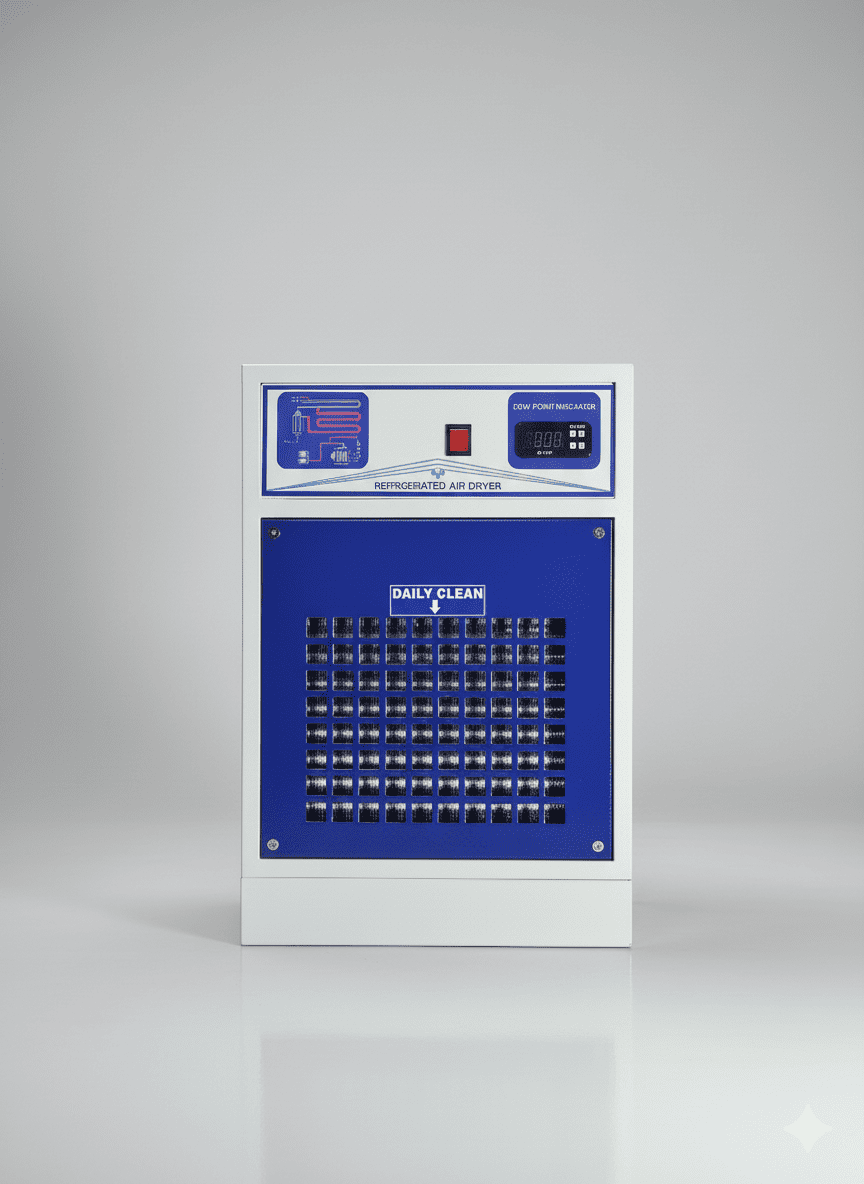
1. Refrigerated Air Dryers
The standard for general manufacturing. These units cool compressed air to a dew point of approximately +3°C. This sudden temperature drop forces water vapor to condense into liquid, which is then automatically discharged.
- Cost-Effective: Low initial capital expenditure and simple operation.
- Durable: Built to withstand standard factory environments.
- Reliable: Consistent performance across typical ambient temperatures.
2. Variable Frequency Dryers
For facilities demanding strict energy control, variable speed technology adapts power consumption to real-time air demand, eliminating the constant energy draw of fixed-speed units.
- Pharmaceuticals & Food/Beverage: Maintains stable dew points under fluctuating demand.
- Electronics Manufacturing: Prevents micro-moisture in cleanroom environments.
- Variable Loads: Ideal for plants with shifting production schedules.
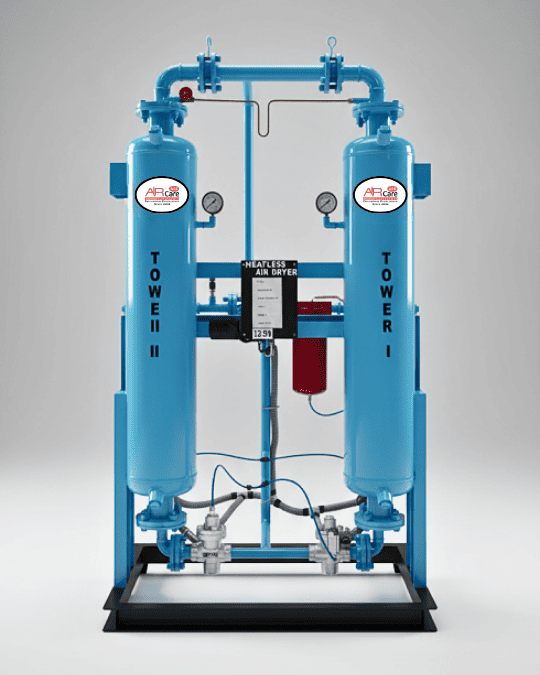
3. Desiccant (Heatless) Air Dryers
When operations require ultra-dry air, standard refrigeration is inadequate. Desiccant dryers route air through twin towers packed with adsorbent materials (like activated alumina) to chemically capture water vapour.
- Ultra-Low Dew Points: Achieves -40°C to -70°C.
- Freeze Prevention: Essential for outdoor piping networks in freezing climates.
- High-Precision: Built for specialised chemical processing and sensitive instrumentation.
Optimising System Integration
Moisture removal does not operate in isolation. To protect the electronic controllers of your drying equipment, we recommend integrating Servo Stabilisers to manage factory voltage fluctuations. Additionally, installing high-efficiency pre-filters upstream prevents bulk liquid and oil carryover from coating the internal heat exchangers or desiccant beads, which causes premature failure.
The Air Care Equipment Standard
We conduct technical air quality audits to specify the exact technology based on your flow rates, working pressures, and ambient conditions.

Technical Sizing & Installation
We position systems for proper ventilation, verify zero-loss drainage, and install correct bypass piping.

Engineered Efficiency
Our components are selected to minimise pressure drop, reducing the total energy burden on your air compressors.

Lifecycle Maintenance
From refrigerant verification to desiccant replacement, our technical team handles all ongoing support.
