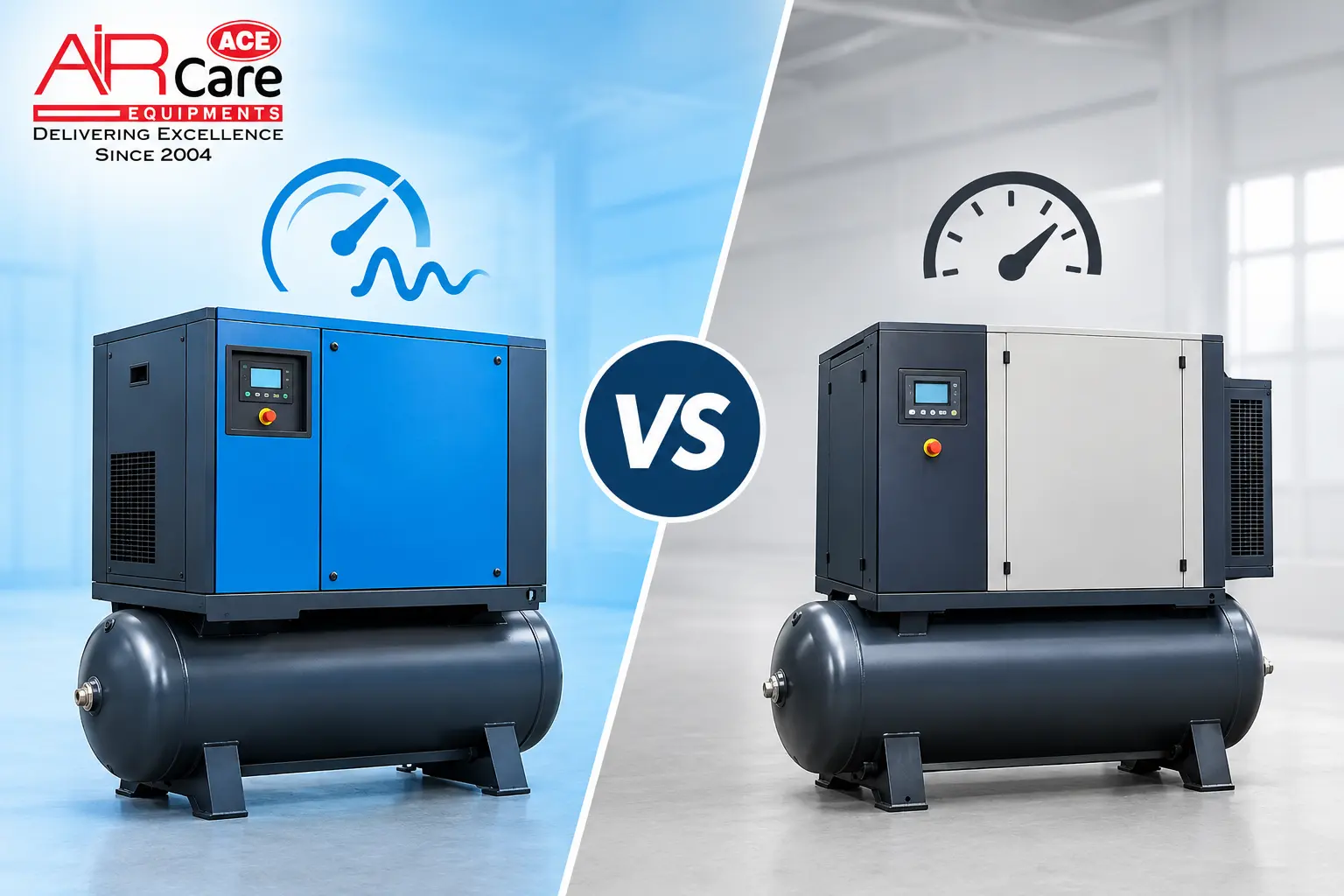
VSD vs Fixed-Speed Screw Compressors: The ROI Calculation for Plant Managers
Every vendor quote for a VSD screw compressor comes with the same pitch: energy savings of up to 35%. It's not wrong, exactly — but it's also not the whole picture, and it's rarely the number you should be using to decide what to actually buy.
The honest answer is that whether a VSD compressor pays for itself in 18 months or never pays for itself at all depends entirely on your load profile — how much your air demand actually varies through a shift. This guide walks through how to run that calculation for your own plant, including the parts most sales conversations conveniently skip.
Why This Decision Comes Down to Your Load Profile, Not Just Price
A VSD (Variable Speed Drive) compressor saves energy by matching its output to demand in real time — slow down the motor when less air is needed, speed it up when more is needed. A fixed-speed compressor, by contrast, runs at one speed and manages demand by loading and unloading.
The catch is that VSD's advantage only shows up when demand actually varies. If your plant runs at a steady 90% of compressor capacity for most of the shift, a fixed-speed unit sized correctly for that load can be just as efficient — sometimes more so. The energy savings VSD is famous for come almost entirely from part-load conditions, so the first real question isn't "which technology is better," it's "how variable is my air demand."
Read More: Top 8 Rotary Screw Air Compressor Manufacturers in India (2026)
How Fixed Speed Screw Compressors Actually Work — and Where They Waste Energy
A fixed-speed screw compressor runs its motor at a constant speed and uses a load/unload cycle to manage output. When system pressure hits the upper setpoint, it unloads (stops compressing but keeps the motor running); when pressure drops to the lower setpoint, it loads again.
At or near full load, this is a genuinely efficient way to run a compressor — there's very little wasted energy because the motor is doing productive work almost continuously. The inefficiency shows up during unloaded running, when the motor is still drawing power (typically 15-25% of full load power) while producing zero usable air. In a plant with steady, high demand, unloaded time is minimal. In a plant with unpredictable, spiky demand, a fixed-speed compressor can spend a surprising amount of its runtime unloaded and still consuming power.
How VSD Compressors Match Output to Demand
A VSD compressor sidesteps the load/unload cycle almost entirely. Instead of running at one speed and switching on and off, it continuously adjusts motor speed to produce exactly as much air as the system is consuming at that moment. Demand drops, the motor slows down; demand spikes, it speeds back up.
This means there's no unloaded running to waste energy on, and pressure stays much more stable — which has a secondary benefit that often gets overlooked: because pressure bands can be set tighter, average system pressure can often be reduced slightly, which lowers energy consumption further and reduces the flow rate of any existing leaks.
Also Read: Air Compressor Maintenance Guide | Checklist & Service Tips 2026
The Real Difference in Energy Consumption — With the Caveats
This is the section that's usually oversimplified, so here it is broken down by demand pattern rather than as one blanket percentage:
Highly variable load (demand swings widely through the shift, or multiple shifts with very different consumption levels): This is where VSD delivers its strongest numbers, commonly in the 25-35% energy savings range compared to an equivalent fixed-speed unit, because the fixed-speed compressor would otherwise spend a lot of time unloaded.
Fairly constant load near full capacity (demand sits at 85-95% of compressor output most of the time): Here the gap narrows significantly, and in some cases a well-sized fixed-speed compressor can match or slightly beat a VSD unit, since VSD motors carry a small efficiency penalty at full speed compared to a standard fixed-speed motor running flat out.
Moderate variability (most plants actually fall here — demand fluctuates with shift changes, batch cycles, or seasonal production swings): Savings typically land in the 12-20% range. This is the group that most needs an actual calculation rather than a rule of thumb, because the outcome genuinely depends on the specifics.
Read More: Air Compressor Sizing Guide: Calculating CFM & PSI for Air Tools
Calculating Payback Period — The Actual Formula
Here's the calculation, worked through with numbers so you can substitute your own:
Payback (years) = Price Premium of VSD ÷ Annual Energy Cost Savings
Say you're comparing a 30 HP fixed-speed screw compressor against an equivalent 30 HP VSD unit:
-
Price premium for VSD: roughly ₹1,50,000 (varies by brand and HP, but this is a reasonable mid-range figure)
-
Operating hours: 20 hours/day, 300 days/year = 6,000 hours annually
-
Average load factor: assume a moderately variable plant running at roughly 65% average demand relative to full capacity
-
Fixed-speed compressor at this load factor: unloaded roughly 30% of run time, drawing about 20% power while unloaded
-
Estimated energy consumption, fixed speed: ~1,58,000 kWh/year
-
Estimated energy consumption, VSD, same load profile: ~1,26,000 kWh/year (a savings of roughly 20%, consistent with the moderate-variability range above)
-
Annual energy saved: 32,000 kWh
-
At ₹8/unit industrial tariff: ₹2,56,000 saved per year
Payback period: ₹1,50,000 ÷ ₹2,56,000 ≈ 7 months
Run the same math on a plant with a steady, near-full-load profile and the annual savings might drop to ₹40,000-₹60,000 — pushing payback out to 2.5-4 years. Neither number is wrong; they're just describing different plants. This is exactly why the calculation needs to be run against your actual load data rather than borrowed from a brochure.
What the Payback Calculation Usually Misses
The energy math above is the headline number, but a few other factors change the real-world picture:
Maintenance costs. VSD units have more electronic components (the drive itself, cooling fans for the drive) that can add to long-term maintenance cost and, eventually, a drive replacement expense that a fixed-speed unit doesn't carry.
Mechanical wear. VSD's soft-start capability reduces mechanical stress on the motor and drivetrain compared to the repeated load/unload cycling of a fixed-speed unit, which can translate into a longer service life for certain components — genuinely useful, but hard to put a precise rupee figure on upfront.
Power quality and harmonics. VSDs introduce harmonic distortion into the electrical supply. In plants with older or already-strained electrical infrastructure, this can require additional filtering equipment — an added cost that's easy to miss if it's not asked about at the quoting stage.
Reduced artificial demand. Because VSD allows tighter pressure control, some plants find they can lower their overall operating pressure by 0.3-0.5 bar without affecting production — a secondary saving that compounds with the direct energy calculation above.
When Fixed Speed Is Still the Smarter Buy
It's worth saying plainly: VSD isn't the right answer for every plant, and a manufacturer that tells you otherwise isn't being straight with you.
Fixed speed remains the better choice when demand is consistently high and stable (little unloaded time to eliminate), when upfront budget is genuinely tight and the load profile doesn't support fast payback, or when the plant doesn't have reliable access to technical support for drive electronics and would rather deal with simpler mechanical components. In these cases, the extra ₹1-2 lakh spent on a VSD unit may take years to earn back, if it ever fully does.
Read More: Choosing the Right Air Compressor: Understanding CFM and Pressure for Pneumatic Tools
A Simple Framework for Making the Call
Before requesting a quote, walk through these four questions:
-
How much does your air demand actually vary across a shift? If you don't know, a short-term data logger on the compressor for a week will answer this more reliably than a guess.
-
How many hours a day does the compressor run, and at what average load? More hours at variable load strengthens the case for VSD.
-
What's your investment horizon? A 3-year budget cycle needs a fast payback; a 7-10 year equipment lifecycle can absorb a longer one.
-
What's the condition of your electrical infrastructure? Older setups may need to budget for harmonic filtering alongside the compressor itself.
Getting an Accurate Quote — What to Ask For
The single biggest mistake plant managers make at the quoting stage is asking for a straight HP-for-HP swap quote—"I have a 30 HP fixed speed, quote me a 30 HP VSD." That skips the one input that actually determines whether VSD makes sense: your load profile.
A better approach is to ask for a sizing recommendation based on actual demand data, not just current HP. Air Care Equipment's VFD screw compressor range, for instance, is sized against logged plant demand rather than a like-for-like swap—which is really the only way to know whether the payback math above will play out in your favor or not.
Frequently Asked Questions
Q1: How long does it typically take for a VSD compressor to pay for itself?
For plants with genuinely variable demand, payback often falls between 6 months and 2 years. For plants running steady, near-full-load conditions, it can stretch to 3-4 years or longer, since there's less unloaded running for VSD to eliminate.
Q2: Is VSD worth it for a plant that runs the same load 24/7?
Usually not as strongly as the marketing suggests. If demand barely fluctuates and the compressor rarely unloads, a correctly sized fixed-speed unit can be just as efficient, and sometimes marginally more so, since VSD motors carry a small efficiency penalty at full speed.
Q3: What's the price difference between a VSD and fixed speed screw compressor of the same HP?
It varies by brand and HP range, but a reasonable ballpark for mid-size industrial units (15-50 HP) is a premium of roughly ₹1-2.5 lakh for the VSD version over an equivalent fixed-speed model.
Q4: Do VSD compressors need more maintenance than fixed speed ones?
The core compressor maintenance (oil, filters, air end servicing) is similar. The additional consideration is the drive electronics, which need to stay clean and adequately cooled, and which represent a replacement cost down the line that fixed-speed units don't have.
Q5: Can I retrofit VSD onto an existing fixed-speed compressor, or does it have to be a new unit?
In some cases, a VSD retrofit kit can be fitted to an existing compressor, but this depends heavily on the motor and drivetrain design of the specific unit. For most standard screw compressors, replacing with a purpose-built VSD unit gives more reliable results than retrofitting.
Recent Posts