Air Compressor Sizing Guide: How to Calculate CFM & PSI for Air Tools
Quick Answer
Find the CFM rating of your most demanding air tool (check the label or manual), then multiply it by a 1.5 safety factor to get your minimum compressor CFM.
Running more than one tool at the same time? Add up each tool's CFM first, then apply the same 1.5x multiplier.
Match that CFM figure to a compressor rated at your tool's required PSI, not just its horsepower.
If you've ever pulled the trigger on an impact wrench and felt the power fade halfway through a bolt, you already know what an undersized compressor feels like. Air tools don't run on horsepower, they run on airflow and pressure. Get those two numbers wrong, and even a brand-new compressor will leave your tools sputtering.
This guide walks through exactly how to size a compressor for the air tools you actually use, with a chart you can use directly, a couple of worked examples, and the mistakes that trip up most first-time buyers.
Why CFM and PSI Matter More Than HP
Horsepower tells you how big the motor is. It doesn't tell you how much air the compressor actually delivers, or at what pressure, and that's the only thing your air tools care about.
Two compressors with the same HP rating can produce very different CFM outputs depending on the pump design, stage count, and efficiency. So when you're sizing a compressor for a specific tool or set of tools, start with these two numbers:
● CFM (Cubic Feet per Minute) — how much air volume the compressor delivers
● PSI (Pounds per Square Inch) — how much pressure the air delivers
Only once you know the CFM and PSI your tools need should you look at HP as a way of comparing compressor models.
Duty cycle matters here too. A single-stage compressor typically tops out at a 50% duty cycle, while a two-stage unit can often sustain 75% or more, which matters a lot if you're running a tool continuously rather than in short bursts.
How to Find Your Air Tool's CFM Requirement
Every pneumatic tool ships with a rated CFM requirement, usually printed on the tool's spec label or listed in its manual. It's typically expressed as a required CFM "at 90 PSI", that's the standard reference point manufacturers use, so make sure you're comparing compressor output at the same PSI.
One thing to watch for: many air tools are rated on a specific duty cycle assumption, often around 25%, meaning the manufacturer assumes the tool runs for about 15 seconds out of every minute. If you're using a tool continuously rather than intermittently (a die grinder running non-stop, for example), the real-world air demand will be higher than the label suggests.
The Sizing Formula
Single tool:
Minimum Compressor CFM = Tool's Required CFM × 1.5
Example: a spray gun rated at 6.5 CFM needs a compressor rated for at least 9.75 CFM (6.5 × 1.5).
Multiple tools running at the same time:
Minimum Compressor CFM = (Sum of all tools' CFM) × 1.5
Example: three impact wrenches at roughly 4–5 CFM each used simultaneously (12–15 CFM combined) would need a compressor rated for at least 18–22.5 CFM once the 1.5x margin is applied.
The 1.5x safety margin exists to cover air loss through hoses and fittings and to keep pressure stable as the tool runs rather than watching it sag the moment the tank drains.
Read More: Air Compressor Parts Explained: Names, Functions & Maintenance
Air Tool CFM Chart
These are general industry-standard estimates for common air tools — always check your specific tool's label, since CFM requirements vary by model and manufacturer.
|
Air Tool |
Typical CFM |
Typical PSI |
Notes |
|
Brad nailer / finish nailer |
0.5–2 CFM |
70–90 PSI |
Very light demand; almost any small compressor works |
|
Air ratchet / small impact wrench |
3–5 CFM |
90 PSI |
Common for tyre and light auto work |
|
Impact wrench (1/2") |
4–8 CFM |
90 PSI |
Higher CFM for heavier-duty models |
|
Die grinder |
4–8 CFM |
90 PSI |
Continuous-use tool — real demand often higher than label |
|
Spray gun (HVLP) |
4–10 CFM |
40–50 PSI |
Requires steady, uninterrupted airflow |
|
Sandblaster |
15–30+ CFM |
90–100+ PSI |
Highest demand on this list; needs a large tank and high CFM |
Single-Stage vs. Two-Stage — Does It Affect Sizing?
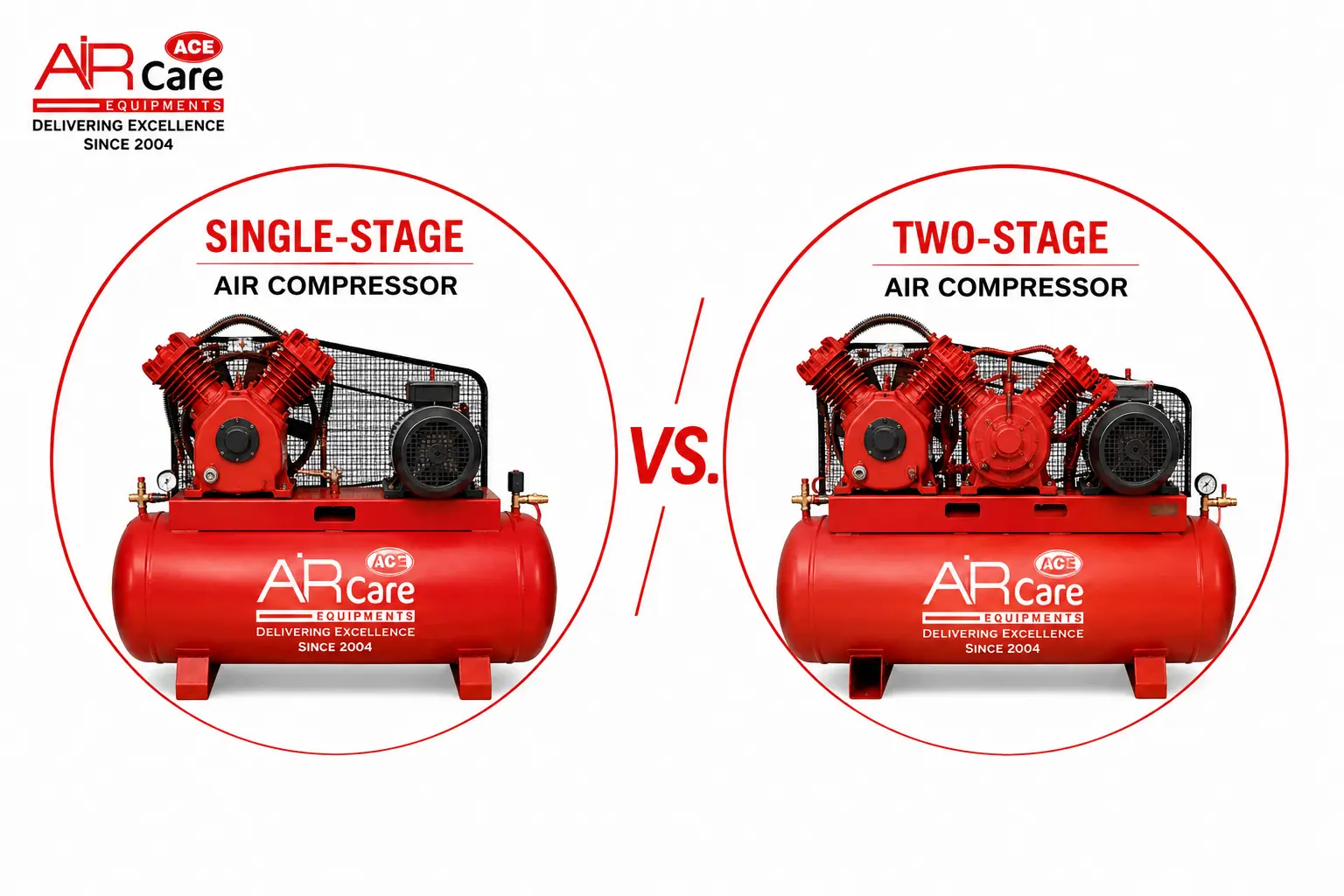
Yes. A single-stage compressor compresses air in one pump stroke and typically has a lower duty cycle (around 50% or less), which means it needs rest periods between bursts of use. A two-stage compressor compresses air twice, first to an intermediate pressure, then further, and can typically sustain a higher duty cycle, often 75% or more.
If your tools run in short, intermittent bursts (an impact wrench for a few seconds at a time), a single-stage unit sized with the formula above is usually enough. If you're running continuous-duty tools, spray guns for extended finishing work, or grinders running non-stop, a two-stage compressor, or a larger CFM buffer, is worth the extra cost.
Running Multiple Tools at Once
If more than one tool could realistically run at the same time on your line, two technicians using impact wrenches simultaneously, for example, you need to size for the combined demand, not just the single highest-CFM tool.
Add up the CFM requirement of every tool that could run concurrently, then apply the 1.5x safety margin to that combined total. This is also where it's worth checking whether your compressor model is rated for multi-tool, multi-outlet use, some lighter-duty portable units are only designed to run one tool reliably at a time.
Can a Bigger Tank Let You Use a Smaller Compressor?
In some cases, yes. A larger receiver tank acts as a buffer, it stores compressed air during quiet periods and releases it during short, high-demand bursts, which means a compressor with a slightly lower CFM rating paired with a bigger tank can sometimes handle intermittent high-CFM tools (like a sandblaster) that it couldn't keep up with on its own.
This only works for intermittent, burst-style demand. If a tool needs high CFM continuously, no tank size will substitute for genuine compressor output, the tank will simply drain and not recover fast enough. We've covered this trade-off in more detail in our guide to choosing the right air compressor tank size, including how to calculate the tank capacity you'd need for your specific demand pattern.
Also Read: Air Compressor Maintenance Guide | Checklist & Service Tips 2026
Matching Your Requirement to an Air Care Equipment Compressor
Once you know your required CFM and PSI, matching it to a compressor is straightforward. As a reference point, Air Care Equipment's 3 HP two-stage piston compressor (ACT-0312) delivers up to 10.6 CFM at 12 bar / 175 PSI with a 150-litre receiver tank built in, suitable for workshop and light industrial use across several tools. The 7.5 HP model steps up to roughly 21.8 CFM with a 250-litre tank for heavier, more continuous demand.
For higher-volume or continuous industrial applications, Air Care Equipment's 10 HP screw compressor range (including VFD/variable-speed models) is built for medium-duty industrial use, worth a direct conversation with the team to match the exact CFM output to your combined tool demand.
Conclusion
Sizing an air compressor for your tools comes down to two numbers, CFM and PSI, not horsepower. Find your most demanding tool's CFM requirement (or the combined total if you're running tools simultaneously), apply a 1.5x safety margin, and match that to a compressor rated at the right PSI for your work.
Get this wrong in either direction and you'll pay for it: undersizing leaves tools stalling and sputtering mid-task, while oversizing means paying for capacity, and floor space, you'll never use.
If you'd rather skip the guesswork, Air Care Equipment's team can help you match your exact tool lineup to the right compressor, from portable single-stage units to industrial screw compressors. Get in touch for a tailored recommendation, or browse our full compressor range to compare CFM and PSI specs directly.
FAQs
Q1: What CFM do I need for an impact wrench?
Most 1/2" impact wrenches need roughly 4–8 CFM at 90 PSI. Apply the 1.5x safety margin, and you'll want a compressor rated for around 6–12 CFM depending on the specific model.
Q2: Is a bigger compressor always better?
Not necessarily. Oversizing wastes money upfront and on electricity, and takes up more floor space than you need. The goal is matching CFM and PSI to your actual tool demand, with a reasonable safety margin, not simply buying the largest unit available.
Q3: Do I need a two-stage compressor for a home garage or small workshop?
For occasional, intermittent tool use (tyre inflation, occasional impact wrench work), a single-stage compressor is usually sufficient. If you're running tools continuously for extended periods, a two-stage compressor's higher duty cycle will serve you better long-term.
Q4: How much CFM do I need to run two tools at once?
Add the CFM requirement of both tools together, then multiply the combined total by 1.5. Two tools each requiring 5 CFM, for example, would need a compressor rated for at least 15 CFM (10 combined × 1.5).
Recent Posts