What Is an FRL? Complete Guide for Indian Industries | Air Care Equipment
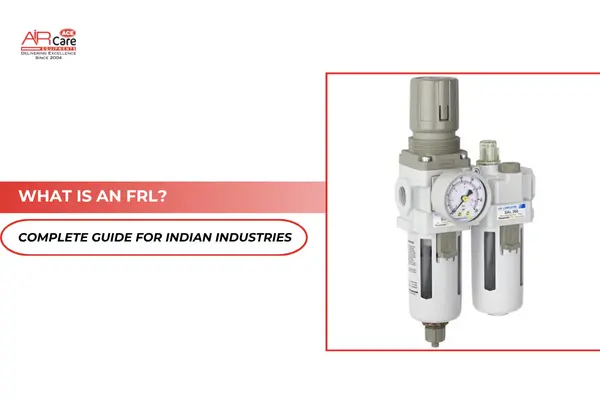
An FRL, short for Filter Regulator Lubricator, is a three-component assembly installed in a compressed air pipeline to clean, control, and lubricate air before it reaches pneumatic tools, cylinders, and valves.
In Indian industrial environments, where ambient humidity is high, monsoon seasons push moisture levels into pipelines, and facilities in zones like Manesar, Bhiwadi, and Okhla deal with significant dust and particulate contamination; a correctly sized FRL is often the single biggest factor in how long your pneumatic equipment lasts.
Air leaving any compressor is hot, dirty, and wet. Without an FRL, this contaminated air shortens the life of every downstream device it touches, from simple pneumatic cylinders to precision spray guns. This guide covers everything you need to know: how each component works, how to choose the right FRL for your application, and how to maintain it for peak performance.
What Does FRL Stand For?
FRL stands for Filter, Regulator, and Lubricator, three separate pneumatic components combined into one assembly. Each letter represents a distinct function:
|
Letter |
Component |
What It Does |
|
F |
Filter |
Removes water, dust, rust, and oil from the compressed air stream |
|
R |
Regulator |
Reduces and stabilises air pressure to the level your tools need |
|
L |
Lubricator |
Injects a measured oil mist to protect moving components from wear |
Why Every Compressed Air System in India Needs an FRL?
India's manufacturing environment creates unique compressed air challenges. Monsoon humidity (June–September) dramatically increases moisture carryover into pipelines. Industrial zones in Haryana, Rajasthan, and Maharashtra face heavy airborne dust. Many facilities operate on 415V/3-phase power with frequent voltage fluctuations that stress compressor performance.
An FRL addresses all three of these threats in a single point-of-use assembly, making it one of the most cost-effective investments in any Indian pneumatic system.
From an energy perspective, every 2 psi increase in operating pressure adds approximately 1% to your compression energy cost. In a factory running a 50 HP screw compressor for 300 days a year, a regulator set 10 psi too high costs roughly ₹40,000–₹80,000 in avoidable electricity annually.
The Three Components of an FRL Explained
1. Airline Filter — Removing Contaminants from Compressed Air
An airline filter cleans compressed air by straining out solid particles (dust, rust, pipe scale) and separating liquids (water, oil) before the air reaches downstream equipment. Filters are installed upstream of all other FRL components, regulators, and air-driven devices.
Filter ratings are measured in micrometres (µm). For most industrial applications in India, a 40–60 µm general-purpose filter provides adequate protection. Point-of-use applications — such as spray painting, pharmaceutical packaging, or laser cutting — require finer filters rated at 5 µm or below, often with a coalescing stage to remove oil aerosols down to 0.01 ppm.
A critical trade-off: finer filter ratings increase pressure drop and clog faster, raising operating costs. A 5 µm filter is not always better — it is only better when your application demands it.
In facilities running Air Care Equipment screw compressors in humid conditions, we recommend pairing a standard 40 µm filter with an automatic float drain — this prevents moisture accumulation in the bowl that would otherwise enter the airline during monsoon months.
2. Pressure Regulator — Controlling Downstream Air Pressure
A pressure regulator (also called a PRV or pressure-reducing valve) reduces and stabilises compressed air pressure to the exact level required by downstream equipment, regardless of fluctuations in the supply line.
Regulators come in two main types: relieving and non-relieving. A relieving regulator exhausts excess downstream pressure automatically — you will hear a hiss, which is normal. A non-relieving regulator traps that pressure, requiring a downstream valve to release it. For most industrial tool applications, a relieving regulator is the correct choice.
Most pneumatic tools used in Indian manufacturing are rated for 6–8 bar (87–116 psi) line pressure but operate optimally at 4–5 bar (58–72 psi). Running tools at full line pressure without a regulator accelerates wear, increases compressed air consumption, and shortens tool life — all avoidable costs.
Important installation note: Always set your regulator output pressure under actual flow conditions — not with tools switched off. The pressure reading at zero flow is misleadingly high and will result in under-pressurised tools during operation.
3. Airline Lubricator — Protecting Pneumatic Components
An airline lubricator adds a precisely metered quantity of oil into the compressed air stream to lubricate valves, cylinders, air motors, and pneumatic tools, reducing friction, preventing wear, and extending service life.
Lubricators come in two types: Oil-fog lubricators are used for single tools, cylinders, or valves and deliver relatively large droplets directly into the airflow. Micro-fog lubricators atomise the oil into fine particles and are used in systems with multiple lubrication points, only around 10% of the visible oil drops in the sight dome actually pass downstream.
A common mistake: intermittent lubrication is often worse than no lubrication. If an oil film dries between uses, it forms sludge or varnish on internal surfaces that is difficult to clean and causes premature failure.
Note for Indian users running VSD screw compressors: if your compressor uses synthetic oil, always install a coalescing filter before the lubricator. Synthetic compressor oils can chemically attack polycarbonate bowls — requiring a metal bowl upgrade or bowl failure.
FRL Selection Guide by Application
The right FRL configuration depends on your application — not just your compressor size. Use this table as a starting point:
|
Application |
Filter type |
Regulator |
Lubricator? |
|
Pneumatic tools (grinders, drills) |
General 5 µm + auto-drain |
Standard relieving |
Yes — oil-fog |
|
Spray painting/powder coating |
Coalescing 0.01 ppm |
Precision |
No — oil-free required |
|
Pharma/food packaging |
Coalescing + vapour removal |
Precision |
No — sterile air |
|
Textile machinery |
General 40 µm |
Standard |
Yes — micro-fog |
|
Laser cutting |
Coalescing high-efficiency |
High-flow precision |
No |
|
Auto assembly (Gurgaon / Pune) |
General 5 µm + coalescing |
Standard relieving |
Yes — micro-fog |
Common FRL Problems and How to Fix Them
|
Problem |
Likely cause |
Fix |
|
Excessive pressure drop |
Filter element clogged or body undersized |
Replace element; upsize body to match flow |
|
Water in air lines downstream of FRL |
Auto-drain not functioning |
Check and replace float drain valve |
|
Tools wearing fast despite lubricator running |
Oil drip rate too low; venturi flow minimum not met |
Adjust needle valve; verify minimum flow rate |
|
Regulator pressure hunting/oscillating |
Worn or damaged diaphragm |
Replace diaphragm kit or full unit |
|
Polycarbonate bowl cracking |
Synthetic oil exposure |
Replace with metal bowl immediately |
|
Low output despite regulator set high |
Undersized regulator orifice for flow demand |
Upsize regulator body; check under-flow conditions |
Why Indian Manufacturers Choose Air Care Equipment
Since 2004, Gurgaon-based Air Care Equipment has been designing, engineering, and servicing robust compressed air systems across India’s automotive, pharmaceutical, textile, and food processing sectors.
We aren't traders reading from a product catalogue. We are manufacturers. When you work with us, you deal directly with the engineers who build the systems.
The Air Care Advantage
-
20+ Years of Expertise: Proven reliability with hundreds of installations across India's major industrial corridors.
-
True Manufacturing: We engineer our own screw compressors, dryers, and pipeline systems rather than reselling imported items.
-
Built for Indian Conditions: Our systems are uniquely designed to handle local voltage fluctuations, intense monsoon humidity, and industrial dust profiles.
-
Comprehensive AMC Support: Includes scheduled FRL (Filter-Regulator-Lubricator) servicing, filter replacements, and proactive health checks.
Engineered for Your Reality
Instead of giving you a generic datasheet recommendation, we size your FRL specifications against your actual compressor output, facility flow demand, and specific contamination risks.
For Indian manufacturers facing seasonal moisture spikes and requiring rapid on-site support, our Gurgaon-based team ensures faster response times and engineers who truly understand your operating environment.
Need Help Choosing the Right FRL for Your Setup?
Air Care Equipment has been supplying and servicing compressed air systems from Gurgaon since 2004, with installations across Haryana, Rajasthan, Maharashtra, and beyond. Whether you're running one of our screw compressors or a third-party system, our engineers can help you specify the correct FRL for your application, flow rate, and pressure requirements.
We also offer Annual Maintenance Contracts (AMC) that include scheduled FRL inspection, filter replacement, and system health checks, so you never have to worry about contaminated air reaching your equipment.
Frequently Asked Questions
Q1: What is the difference between an FRL and an FR (Filter Regulator)?
An FR (Filter Regulator) is a two-component unit that cleans and controls air pressure but does not lubricate. An FRL adds a lubricator, making it suitable for applications where pneumatic tools, motors, or cylinders require oil for longevity. Use an FR where oil-free air is required, such as spray painting, food processing, or pharmaceutical applications.
Q2: Where should an FRL be installed in a compressed air system?
An FRL should be installed as close to the point of use as possible, immediately upstream of the tool, machine, or valve it is protecting. Installing it at the compressor outlet is not effective because contamination and moisture accumulate in pipelines between the compressor and the end tool.
Q3: How often should I change the FRL filter element?
In Indian conditions, particularly during and after monsoon season, inspect filter bowls every 2–4 weeks and replace filter elements every 3–6 months depending on contamination levels. High-dust environments (foundries, stone cutting, textile mills) may require monthly replacement.
Q4: Can I use an FRL without the lubricator for oil-free applications?
Yes. Most modular FRL assemblies allow you to configure an FR (filter + regulator only) by omitting the lubricator module. For oil-sensitive processes, this is the correct configuration, and a coalescing filter should be added to remove any compressor oil aerosols that pass through the standard filter.
Q5: What FRL do I need for a screw air compressor?
Screw compressors typically deliver air at 7–10 bar, often with residual oil aerosols from the lubrication system. For a screw compressor feeding pneumatic tools, specify a 5 µm general-purpose filter with auto-drain, a standard relieving regulator sized for your peak flow (CFM), and an oil-fog lubricator. If the compressor uses synthetic oil, use a metal bowl on your FRL.
Q6: Do I need an FRL if I have an oil-free compressor?
Yes, even oil-free compressors produce compressed air that contains moisture and particulates from the ambient environment. You still need a filter and regulator. The lubricator may be omitted for oil-sensitive applications, but the FR components remain essential for protecting downstream equipment.
Recent Posts