7 Most Common Uses of Industrial Air Compressors | Sector Guide
Quick Answer: Industrial air compressors are used across manufacturing, pharmaceuticals, food processing, construction, automotive, laser cutting, and electronics to power pneumatic tools, automate assembly lines, control processes, and deliver clean compressed air. In India, screw and reciprocating compressors in the 5 HP to 100 HP range handle the majority of these applications.
Walk through almost any production floor in India, whether it is an auto ancillary unit in Manesar, a pharmaceutical plant in Baddi, or a food packaging line in Gurgaon, and you will find an air compressor running in the background. It is one of those pieces of equipment that does not get much attention until it stops working, at which point everything else stops working too.
Air compressors have been called the fourth utility in manufacturing, after electricity, gas, and water. That description holds up. The range of tasks they handle is broader than most people realise, and the consequences of choosing the wrong compressor for a specific application, wrong pressure, wrong type, wrong duty cycle, show up quickly in product quality, machine downtime, and energy bills.
Air Care Equipment has been manufacturing industrial air compressors in Gurgaon since 2004. In two decades of working with factories, fabrication shops, pharma plants, and contractors across India, seven applications come up consistently. This blog covers each one, what the application actually demands from a compressor, and which type meets that demand.
What Is an Industrial Air Compressor and How Does It Work?
An industrial air compressor draws in atmospheric air, compresses it to a higher pressure using a motor-driven mechanism, and stores or delivers that compressed air to power tools, machinery, or process equipment. The two key specifications that determine whether a compressor fits an application are pressure, measured in bar or PSI, and flow rate, measured in CFM (cubic feet per minute) or LPM (litres per minute).
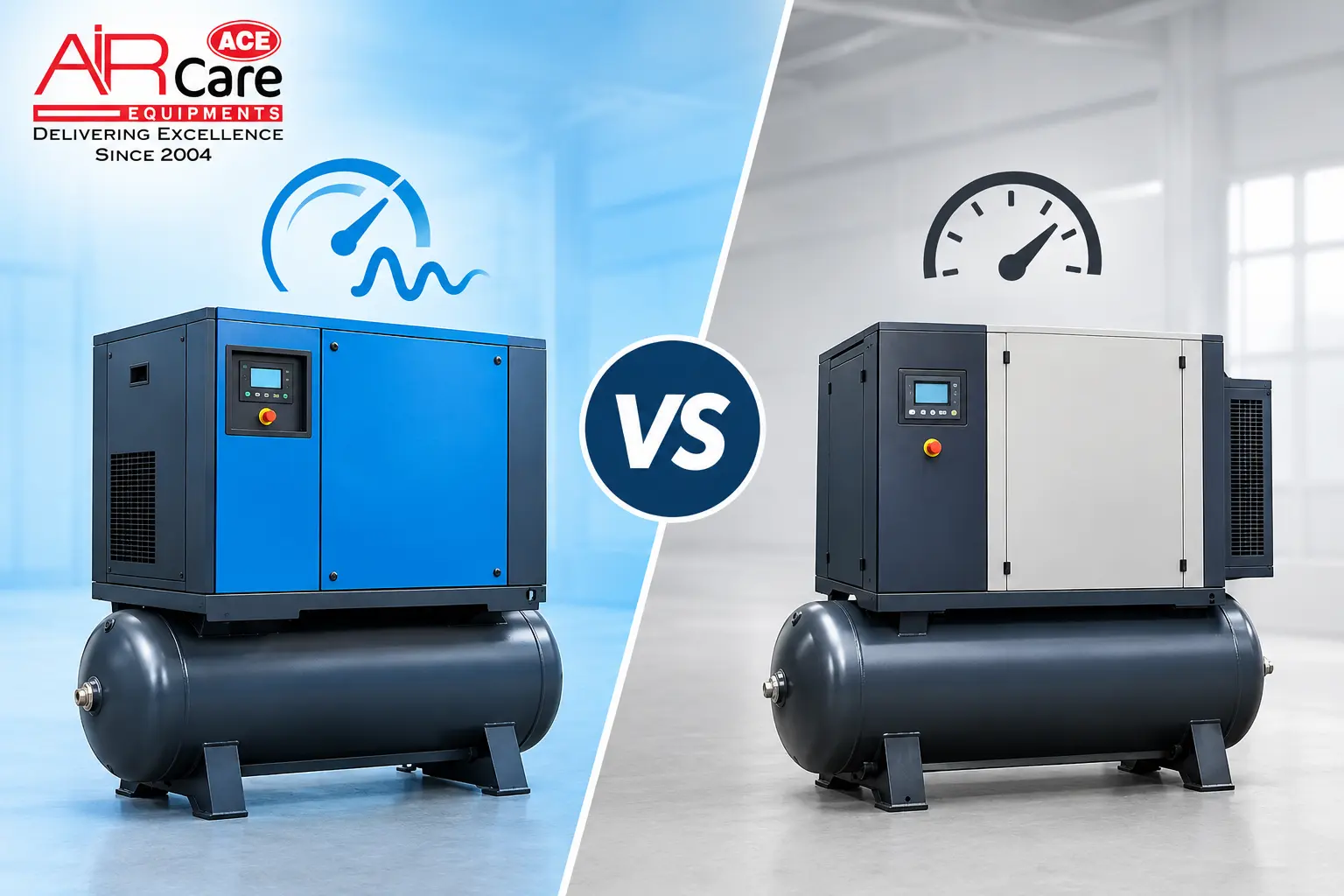
For the Indian industry, two compressor types dominate most applications. The reciprocating (piston) compressor uses pistons driven by a crankshaft to compress air in cycles. It is the workhorse of workshops, fabrication units, and smaller manufacturing setups where demand is intermittent. The screw compressor uses two interlocking helical rotors to compress air continuously and quietly. It is built for production environments where the compressor needs to run all day without stopping.
Both types have their place, and the right choice depends entirely on what the compressed air will be used for. The seven applications below cover the full range.
What Are the Seven Most Common Industrial Uses of Air Compressors?
Compressed air powers or assists a remarkably wide range of industrial processes. The seven uses below are the ones seen most frequently across Indian manufacturing and construction — each with different pressure, flow, and air quality requirements.
1. Powering Pneumatic Tools on Manufacturing Floors
|
Quick Answer — Pneumatic Tools |
|
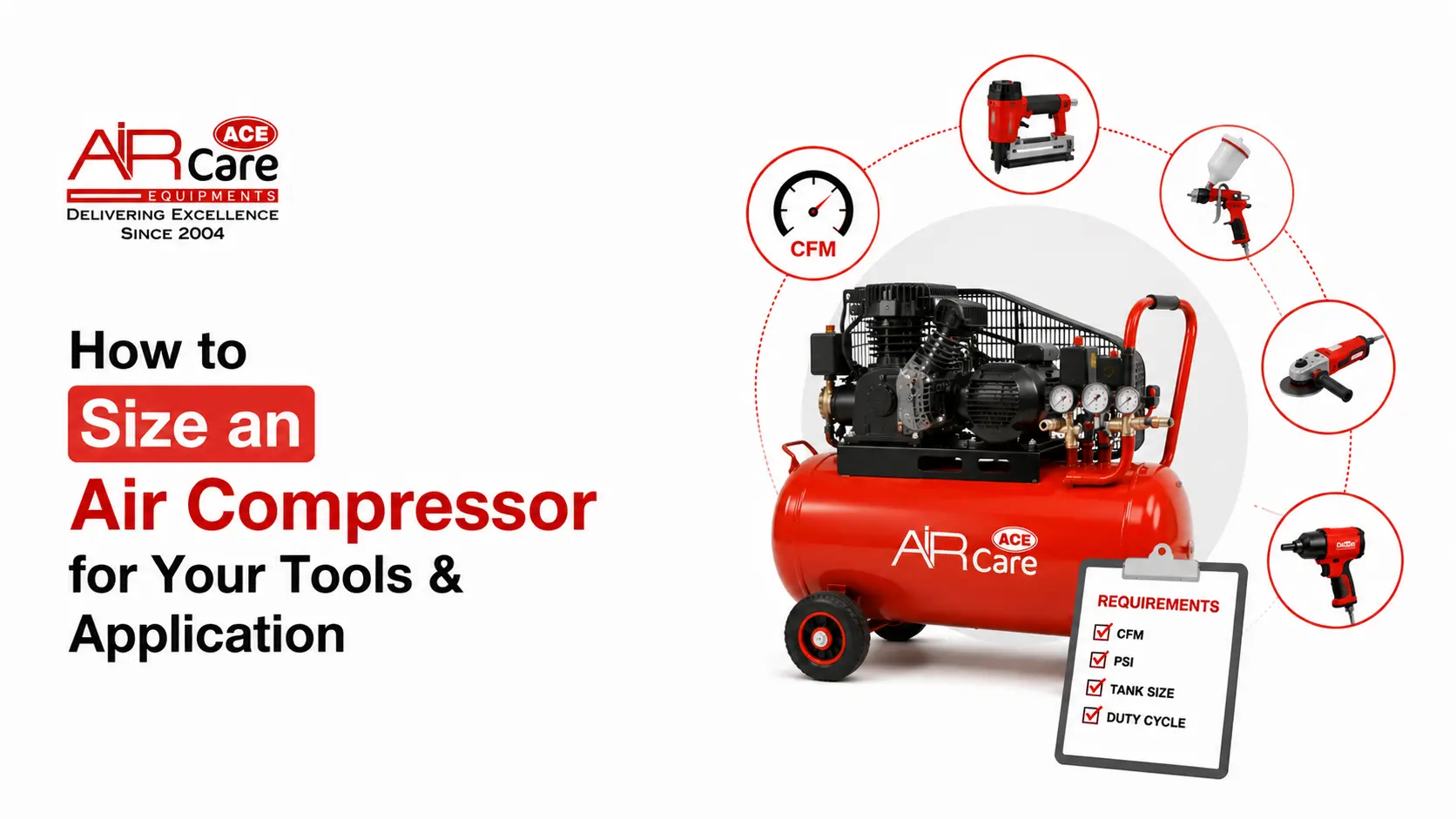
Pneumatic tools including angle grinders, impact wrenches, spray guns, drill machines, and nail guns run on compressed air at 90–120 PSI (6–8 bar). Reciprocating air compressors in the 3 HP to 15 HP range are the standard choice for tool-heavy workshops where demand is intermittent. |
This is where most people encounter industrial compressed air for the first time. Pneumatic tools — powered by compressed air rather than electricity — are faster, lighter, and more durable than their electric counterparts for high-torque, repetitive tasks. An air-powered impact wrench, for example, delivers far more torque per kilogram of tool weight than an electric one, and it does not overheat when used continuously.
Common pneumatic tools found on manufacturing floors and in auto workshops include:
• Angle grinders and cut-off tools
• Impact wrenches and ratchets
• Pneumatic drill machines
• Spray paint guns
• Riveting tools and nail guns
• Sandblasting guns (smaller scale)
• Air-powered chisels and hammers
The compressed air requirement for most pneumatic tools sits between 90 and 120 PSI (6–8 bar), with CFM demand varying by tool size. A single impact wrench might need 4–6 CFM, while a busy workshop running five to six tools simultaneously needs a compressor sized accordingly.
Because workshop tool use is intermittent — tools run for a burst, then stop — a reciprocating (piston) compressor suits this application well. It compresses air into a receiver tank, shuts off when pressure reaches the set point, and kicks back on when pressure drops. This on-off cycle matches real workshop demand patterns without the energy cost of a continuously running screw compressor.
Auto ancillary workshops and fabrication units across the NCR, Ludhiana, and Pune belt run almost entirely on reciprocating compressors in the 3 HP to 15 HP range for exactly this reason.
2. Automating Assembly Lines in Automotive and Electronics Plants
|
Quick Answer — Assembly Line Automation |
|
Assembly line automation uses compressed air to operate pneumatic cylinders, actuators, clamping devices, and robotic pick-and-place arms. Screw air compressors running at 7–10 bar provide the continuous, stable airflow that automated systems require without pressure drops or interruption. |
Automated assembly lines do not run on electricity alone. Behind every pneumatic cylinder that clamps a part, every actuator that pushes a component into position, and every pick-and-place arm that moves a product down the line, there is a compressor running continuously in the background.
The difference between this application and powering hand tools is the duty cycle. Assembly lines run eight to twenty-four hours a day. A reciprocating compressor is not built for this — it needs cooling time between cycles, and running it continuously leads to overheating, valve failure, and early breakdown. Screw compressors are designed for 100% duty cycle operation. They run continuously, deliver stable pressure, and do not overheat.
Flow rate requirements also scale up significantly in automated environments. A single pneumatic cylinder needs very little CFM, but a line running thirty or forty pneumatic devices simultaneously needs a compressor delivering 50 to 500 CFM, depending on line size. VSD (Variable Speed Drive) screw compressors are particularly well-suited here because they adjust motor speed to match actual air demand, which cuts energy consumption by 20 to 35 per cent compared to a fixed-speed compressor running at partial load.
Automotive plants along the Gurgaon-Manesar corridor, supplying components to Maruti Suzuki, Hero MotoCorp, and other OEMs, and electronics assembly units in Noida and Bengaluru use screw compressors as the backbone of their compressed air systems for this reason.
3. Spray Painting and Surface Finishing
|
Quick Answer — Spray Painting |
|
Compressed air atomises paint into fine droplets for uniform surface coverage in automotive, furniture, and metal fabrication applications. Oil-free air compressors are mandatory for spray finishing — even trace oil in the airstream causes paint adhesion failure and coating defects. |
Spray painting with compressed air has been the standard for industrial surface finishing for decades, and for good reason. Compressed air atomises liquid paint into a fine, consistent mist that produces a uniform coat without brush marks or roller texture. The finish quality — even on complex geometries like car bodies, furniture frames, or fabricated metal components — is difficult to match with any other method.
The critical requirement for this application is air quality, not just pressure. Standard lubricated compressors carry oil aerosols in their output air. At spray painting pressures of 25 to 50 PSI, even a very small amount of oil contamination in the airstream — often invisible to the eye — lands on the surface being painted and causes fish-eye defects, adhesion failure, and coating separation. In automotive and furniture finishing, these defects mean the entire surface needs to be stripped and repainted, which is an expensive and time-consuming problem.
Oil-free compressors eliminate this problem at the source. They do not use oil in the compression chamber, so the output air is clean by design. An additional inline air filter and moisture separator are standard practice, but the foundation of contamination-free air comes from the compressor itself.
Industries where this matters most in India include automotive body shops, furniture manufacturers in Rajasthan and UP, and metal fabricators painting structural components or consumer goods.
4. Food and Beverage Packaging and Processing
|
Quick Answer — Food Processing |
|
Food and beverage plants rely on compressed air for bottle blowing, cap sealing, pneumatic filling machines, and product conveying. Oil-free compressors paired with refrigerated air dryers are the standard — any oil or moisture contamination in food-contact air violates FSSAI quality requirements. |
Compressed air in food and beverage manufacturing is not just a utility — it is a process input that comes into direct or indirect contact with food products. That distinction changes what type of compressor is acceptable.
In a packaged water or beverage plant, compressed air blows PET preforms into bottles (at 35–40 bar for bottle blowing), operates pneumatic filling heads, actuates conveyor guides, and seals caps. In a packaged food line, it pneumatically conveys grain, flour, or powder from storage to filling stations. In a bakery or dairy, it cleans equipment between product runs.
In all of these cases, air quality is non-negotiable. Any oil carry-over from a standard lubricated compressor contaminates the product or its packaging. Moisture in the compressed air causes microbial growth in pipelines and on equipment surfaces — a hygiene problem with serious food safety implications. FSSAI standards for food processing facilities require clean, dry, contaminant-free process air.
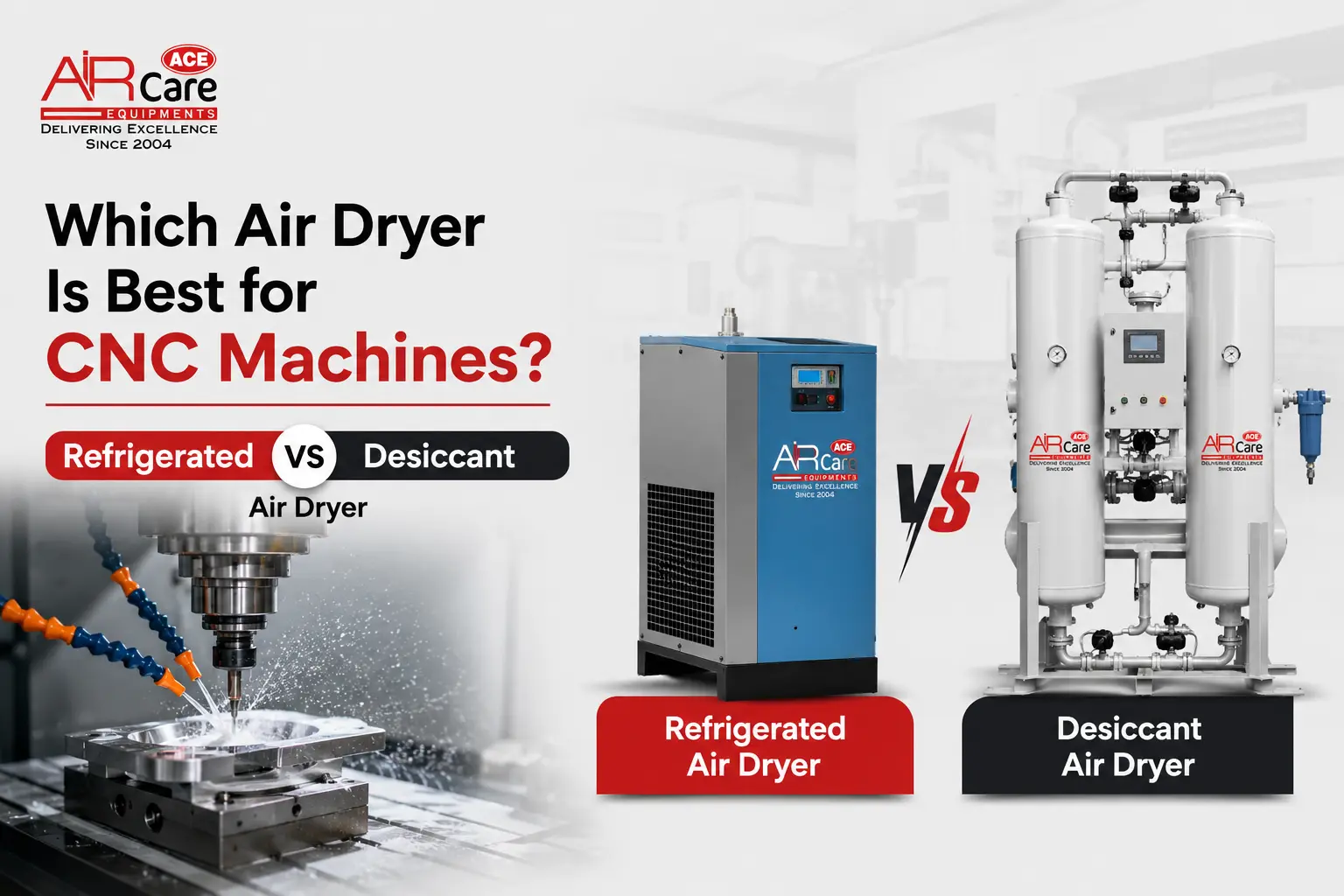
The solution has two components: an oil-free air compressor ensures no oil enters the system, and a refrigerated air dryer removes moisture by cooling the compressed air below its dew point, condensing water vapour out of the airstream before it reaches the process. Together, they produce food-grade compressed air that meets quality and safety requirements.
FMCG and packaged food manufacturers across Haryana, Rajasthan, and UP increasingly specify oil-free and dryer-equipped compressed air systems as a baseline, particularly those supplying to national brands with supplier quality requirements.
5. Laser Cutting Operations
|
Quick Answer — Laser Cutting |
|
Laser cutting machines use high-pressure compressed air at 8 to 16 bar as an assist gas to blow molten material out of the cut path and protect the focusing lens from debris and spatter. A dedicated, dry, oil-free compressed air supply is essential — moisture or oil on the lens causes permanent damage and poor cut quality. |
Laser cutting has grown rapidly across Indian manufacturing over the past five years. Sheet metal fabricators, component manufacturers, and engineering shops that used to depend on plasma cutters or waterjet machines have moved to fibre laser systems for the speed, precision, and low operating cost they offer. What is less widely discussed is that the compressed air supply to a laser cutting machine is just as important as the laser source itself.
Compressed air in a laser cutter does three things. First, it acts as the assist gas for cutting mild steel — blowing molten metal out of the kerf (cut path) so the laser can continue cutting rather than heating an expanding pool of molten material. Second, it creates a positive-pressure zone around the cutting head that keeps smoke, fumes, and spatter away from the focusing lens. Third, on machines with automatic nozzle cleaning, compressed air purges the nozzle between cuts.
The pressure requirement — 8 to 16 bar — is higher than most general workshop compressors deliver. Standard 6–8 bar shop compressors are insufficient for this application and can cause poor cut quality, dross on the cut edge, and accelerated nozzle wear. High-pressure air compressors or dedicated laser cutting compressors sized specifically for this duty are the correct specification.
Air quality matters just as much as pressure. Oil droplets in the airstream coat the focusing lens and cause it to absorb laser energy rather than transmit it — leading to lens cracking or shattering, which is a costly and dangerous failure. Moisture causes oxidation of the cut edge and inconsistent cut quality. The compressed air supply to a laser must be dry and oil-free before it reaches the machine.
Fibre laser installations in sheet metal fabrication clusters in Gurgaon, Ludhiana, Coimbatore, and Pune face this requirement consistently.
6. Pharmaceutical Manufacturing and Laboratory Applications
|
Quick Answer — Pharmaceuticals |
|
Pharmaceutical plants use instrument-grade compressed air that is oil-free, dry, and particle-free for tablet pressing, capsule filling, clean room pressurisation, and powder conveying. ISO 8573-1 Class 1 air purity is the benchmark. Oil-free compressors paired with heatless air dryers achieve dew points as low as -40°C for ultra-dry instrument air. |
Pharmaceutical manufacturing is one of the most demanding environments for compressed air quality. The air is not just a utility, it is effectively a process ingredient. When compressed air contacts an active pharmaceutical ingredient, a tablet during pressing, a capsule during filling, or a sterile surface during cleaning, any contamination in that air becomes contamination in the product.
The applications within a pharma plant are varied. Tablet presses use compressed air to eject tablets from dies. Blister packaging machines use it to form cavities and seal foil. Pneumatic conveyors move fine powders, which may be potent APIs, between processing stages. Clean rooms are maintained at positive pressure using filtered, conditioned air to prevent particulate ingress. Fermentation reactors may use compressed air for agitation or sparging.
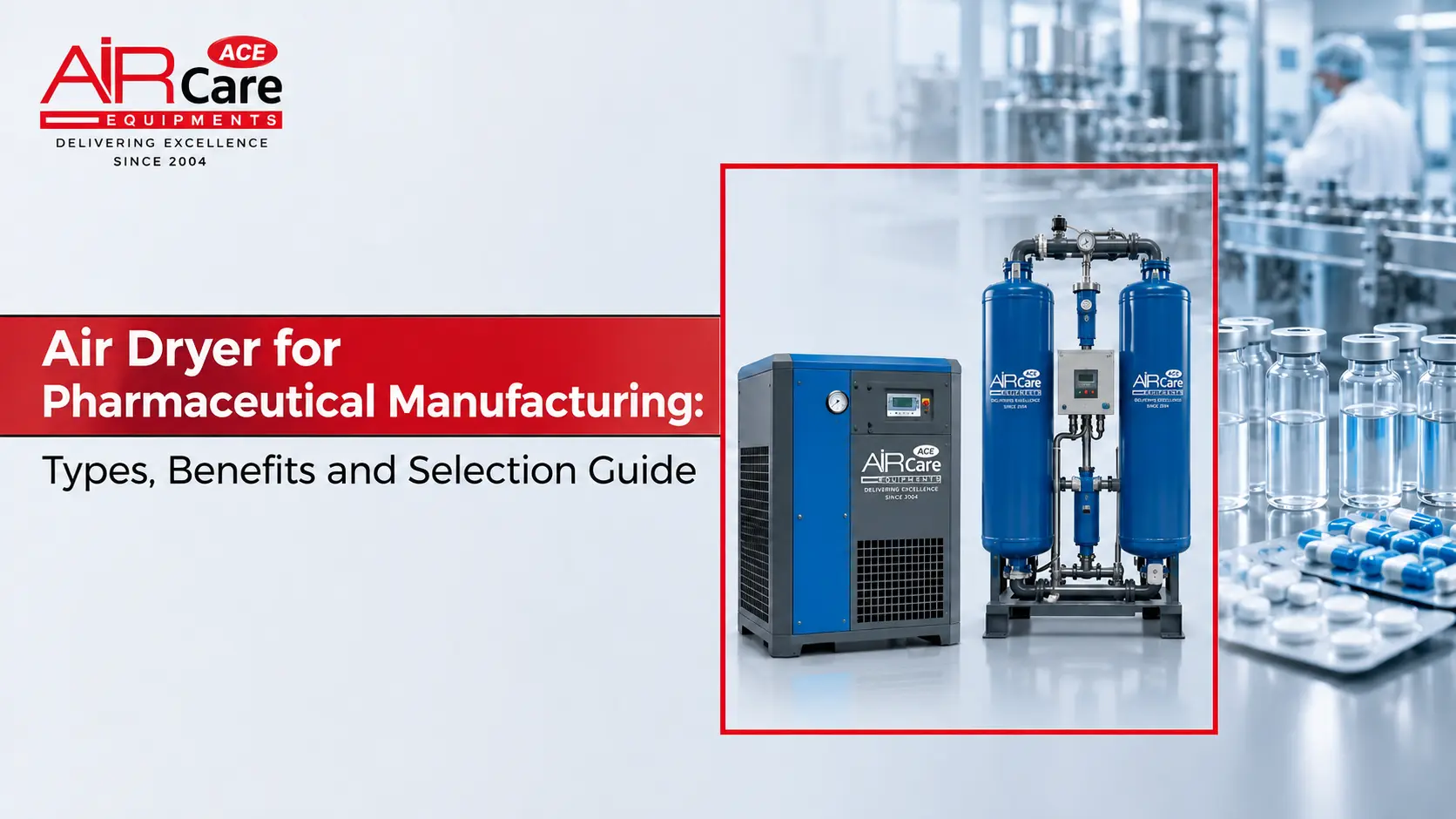
Across all of these, the air purity requirement is ISO 8573-1 Class 1 — the most stringent grade, requiring an oil content of less than 0.01 mg/m⊃3; and a pressure dew point of -70°C or better for the most critical applications. Standard refrigerated dryers cannot reach these dew points. Heatless desiccant dryers — which use activated alumina or silica gel to adsorb moisture from the airstream, achieve pressure dew points of -40°C to -70°C and are a standard specification for instrument air in pharma plants.
The combination of an oil-free compressor and a heatless dryer is the baseline specification for pharmaceutical compressed air in India. Plants in Baddi (Himachal Pradesh), Hyderabad's pharma cluster, and Ahmedabad's pharmaceutical manufacturing belt consistently specify this combination.
7. Construction, Sandblasting, and Heavy Civil Works
|
Quick Answer — Construction |
|
On construction sites, air compressors power jackhammers, concrete breakers, pneumatic tampers, sandblasting equipment, and rock drills. High-pressure reciprocating compressors operating at 10 to 30 bar are standard for heavy civil and surface preparation applications. |
Construction and civil infrastructure work represent one of the most physically demanding environments for compressed air equipment. The compressors here need to be tough, portable enough to move between job sites, and capable of delivering high-pressure air for sustained periods under harsh conditions.
The primary applications are pneumatic braking, jackhammers and concrete breakers that break road surfaces, foundations, and structural concrete for demolition or modification, and sandblasting, where abrasive media is propelled by high-pressure air to clean, roughen, or strip surfaces. Structural steel fabricated for bridges, industrial buildings, and infrastructure projects is sandblasted before painting to remove mill scale and rust and create a surface profile for primer adhesion. Rock drills used in tunnelling and mining are also air-powered.
Pressure requirements in this category are significantly higher than in most manufacturing applications. Jackhammers and concrete breakers typically need 10–14 bar. Industrial sandblasting for heavy structural work requires 10–12 bar with high CFM to keep the blast nozzle fed at consistent velocity. Rock drilling can require up to 30 bar.
Reciprocating air compressors in high-pressure configurations are the standard choice here. They are durable, straightforward to maintain in field conditions, and available in configurations that deliver the pressure and CFM combinations construction applications need.
With infrastructure spending in India accelerating, highway projects, metro expansions, industrial park development, the demand for high-pressure compressors in construction applications has grown steadily across Haryana, Rajasthan, UP, and Maharashtra.
Which Industrial Air Compressor Type Is Right for Your Application?
The table below maps each of the seven applications to the correct compressor type, pressure range, and the single most important technical requirement for that use case. This is a starting point — actual sizing requires calculating total CFM demand, factoring in duty cycle, and accounting for pipeline losses.
|
Use Case |
Recommended Compressor |
Pressure Range |
Key Requirement |
|
Pneumatic tools & workshops |
Reciprocating (Piston) |
6–8 bar |
Intermittent duty, cost-effective |
|
Assembly line automation |
Screw — Direct Drive / VSD |
7–10 bar |
Continuous duty, stable CFM |
|
Spray painting & surface finishing |
Oil-Free Piston |
2–4 bar |
Zero oil contamination in airstream |
|
Food & beverage processing |
Oil-Free + Refrigerated Dryer |
6–8 bar |
Food-grade, moisture-free air |
|
Laser cutting operations |
High-Pressure / Laser-Specific |
8–16 bar |
Dry, clean, lens-safe air |
|
Pharmaceutical manufacturing |
Oil-Free + Heatless Dryer |
6–10 bar |
ISO 8573-1 Class 1 air purity |
|
Construction & sandblasting |
High-Pressure Reciprocating |
10–30 bar |
High output, rugged build |
A note on sizing: pressure (bar/PSI) is only half the specification. CFM, the volume of air the compressor delivers, must match the total demand of all connected tools and processes running simultaneously. Undersizing on CFM causes pressure drops across the system, which is one of the most common sources of quality problems and machine malfunctions in Indian manufacturing. If you are unsure about sizing, Air Care Equipment's team can assess your load and recommend the right configuration.
What Should You Check Before Buying an Industrial Air Compressor in India?
Choosing a compressor on horsepower rating alone is a common mistake. These are the practical checks that prevent a mismatched purchase:
-
Required CFM and pressure: List every tool and process that will draw air simultaneously. Add up the CFM requirements and use the highest pressure requirement across the group. This gives your minimum compressor specification.
-
Duty cycle: If your process runs continuously, a screw compressor is the correct choice. Reciprocating compressors are suited for intermittent use. Running a piston compressor at 100% duty cycle shortens its life significantly.
-
Oil-free vs lubricated: If your process involves food, pharmaceuticals, electronics, or spray finishing, oil-free is not optional. For general tool use and construction, lubricated compressors are more cost-effective.
-
Power supply: Three-phase power is standard for compressors above 5 HP. Smaller setups running on single-phase need to verify the available amperage before purchasing.
-
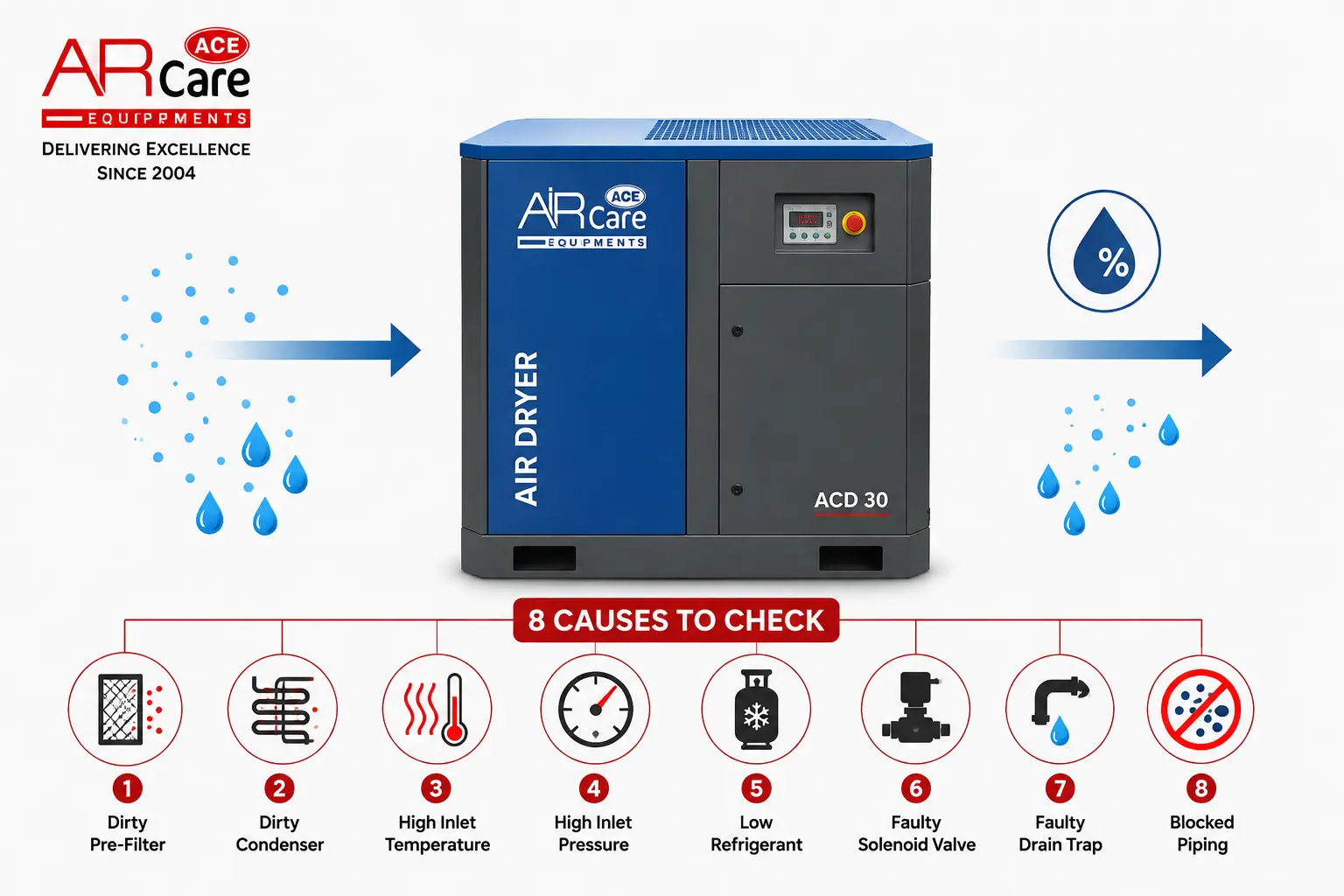
Dryer requirement: In India's climate, particularly in monsoon months, moisture in compressed air is a persistent problem. A refrigerated dryer is standard practice for most industrial applications; a heatless dryer for pharma and precision instrument air.
-
After-sales support: A compressor without local service support is a liability. Check for AMC (Annual Maintenance Contract) availability, spare parts access, and response time before purchasing.
Getting the Right Compressor for Your Application
A compressed air system that is correctly sized and correctly specified for its application runs longer, costs less to operate, and does not cause problems downstream, in product quality, machine reliability, or energy bills. One that is mismatched on type, pressure, or air quality creates exactly those problems, and usually at the worst possible time.
Air Care Equipment has been manufacturing industrial air compressors in Gurgaon since 2004. The product range covers reciprocating compressors for workshops and tool use, screw compressors in fixed-speed and VSD configurations for production lines, oil-free compressors for food and pharma applications, high-pressure compressors for construction and laser cutting, and the full range of air treatment equipment including refrigerated and heatless dryers.
If you are specifying a new system or looking to replace an existing compressor, the team at Air Care Equipment can help you size the right unit for your actual load. Annual Maintenance Contracts are available for all equipment supplied.
Frequently Asked Questions
Q1. What is the most common use of an industrial air compressor?
Powering pneumatic tools is the most widespread application across Indian industry, found in everything from auto workshops and fabrication units to construction sites. Assembly line automation comes second, followed by spray finishing and surface treatment.
Q2. Can one air compressor handle multiple applications at once?
Yes, provided it is sized correctly. A screw compressor with adequate CFM and pressure can supply a pipeline network serving multiple pneumatic tools and automated devices simultaneously. The key is ensuring total system demand — all connected loads running at the same time — does not exceed the compressor's rated output.
Q3. What type of air compressor is used in pharmaceutical plants?
Oil-free air compressors paired with heatless desiccant dryers are the standard specification for pharmaceutical manufacturing. This combination achieves ISO 8573-1 Class 1 air purity — which requires oil content below 0.01 mg/m⊃3; and pressure dew points as low as -40°C to -70°C for instrument air.
Q4. Is a screw compressor better than a piston compressor for industrial use?
It depends on the application. Screw compressors are better for continuous-duty, high-CFM environments like assembly lines, where they run all day without overheating and deliver stable pressure. Reciprocating compressors are the more cost-effective choice for intermittent use in workshops and smaller manufacturing setups.
Q5. What pressure does a laser cutting machine need from a compressor?
Laser cutting machines typically require 8 to 16 bar of clean, dry, oil-free compressed air. Standard workshop compressors operating at 6 to 8 bar are insufficient for this application and can cause poor cut quality and lens damage. A dedicated laser cutting compressor or high-pressure compressor is the correct specification.
Q6. Where can I buy an industrial air compressor in Gurgaon?
Air Care Equipment manufactures screw compressors, reciprocating compressors, oil-free compressors, high-pressure compressors, and laser cutting compressors from its facility in Kadipur Industrial Area, Gurgaon, and supplies across India with branches in Bhiwadi and Jhajjar. Contact: +91-9599297326 | sales@aircareequipment.co.in
Recent Posts