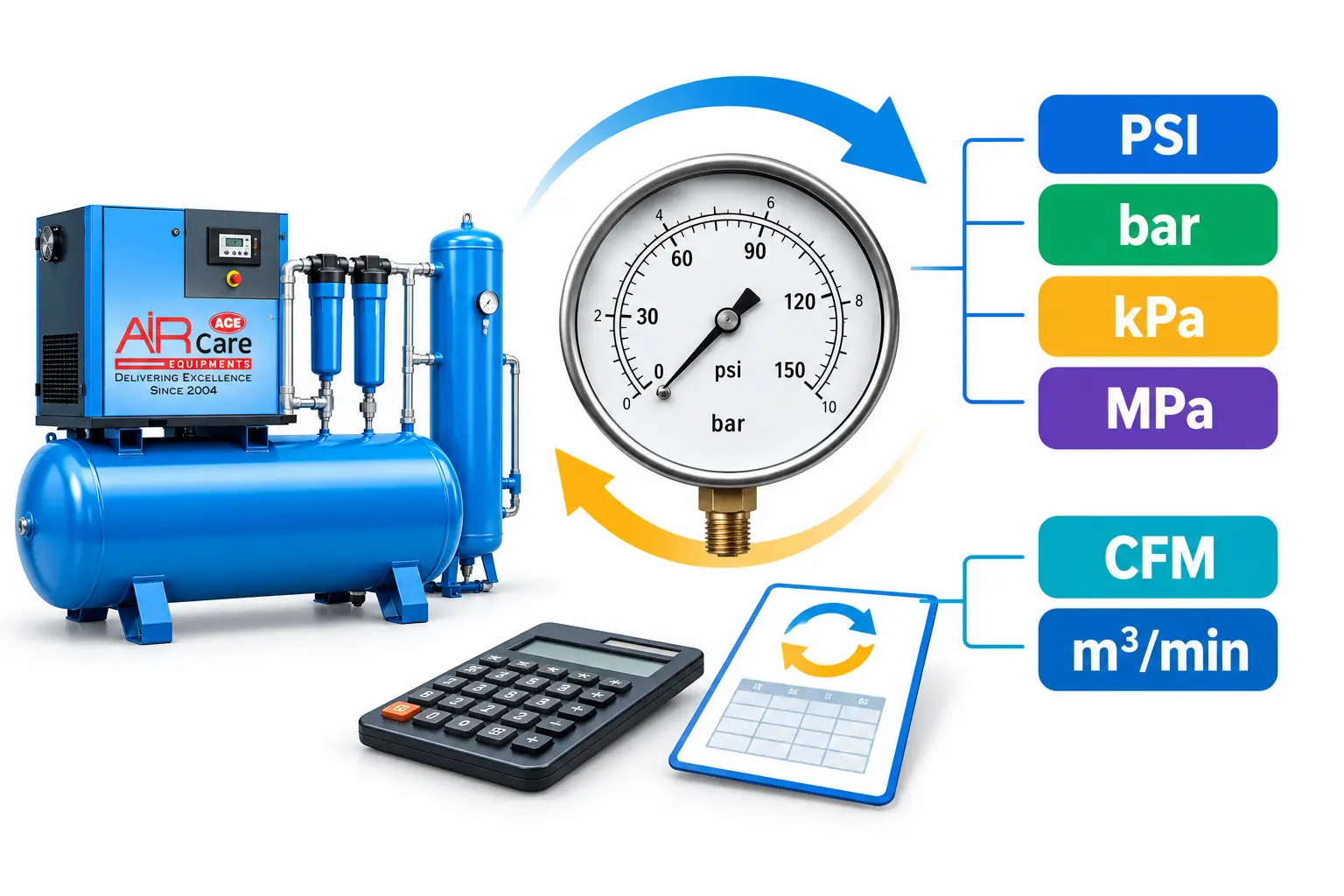
Compressed Air Unit Conversion: A Complete Guide to Pressure, Flow, and Volume
Quick Answer
Compressed air unit conversion helps you compare compressor capacity, airflow, and pressure in different units. For example, you can convert litres per second (L/s) to cubic feet per minute (CFM) or pounds per square inch (PSI) to bar.
These conversions help when choosing an air compressor, checking equipment specifications, or planning an industrial air system. The catch is the simple basic formulas. However, it's important to compare airflow numbers under the same reference conditions.
Key Takeaways
-
Converting compressed air units makes it easier to compare compressor specifications.
-
To convert L/s to CFM, multiply the value by 2.119.
-
To convert m3/min to CFM, multiply the value by 35.315.
-
To convert CFM to m3/hr, multiply the value by 1.699.
-
To convert PSI to bar, multiply the value by 0.06895.
-
An airflow conversion calculator saves time when you need to check multiple values.
-
Always check the rated airflow, working pressure, and reference conditions before choosing a compressor.
What Is Compressed Air Unit Conversion?
Airflow, pressure, and volume are measured in different units in compressed air systems. Compressor capacity can be expressed in either L/s, CFM, m3/min, or m3/hr. Pressure can be measured in PSI, bar, or kilopascals (kPa).
This can be confusing when comparing equipment. One supplier might list a compressor at 100 CFM. Another might list a similar model at 170 m3/hr. Both numbers are related to airflow, but in different units.
A compressed air unit conversion changes a measurement from one unit to another without changing its meaning, as long as the reference conditions stay the same.
For example, 10 L/s is about 21.19 CFM. This conversion makes it easier to compare the two figures.
However, airflow is not the only factor to consider. A compressor must also supply the pressure your equipment needs. Accurate conversions help you compare options more accurately before you buy or install a machine.
Read More: CFM vs PSI Explained: Choose the Right Air Compressor for Industrial Efficiency
Why Are Airflow and Pressure Units Important?
Airflow tells you how much air a compressor can deliver over time. Pressure tells you the force level available to operate a tool or process.
Both values matter when selecting an air compressor CFM rating.
Imagine a workshop that uses pneumatic tools. Each tool needs a certain airflow and working pressure. If the compressor supplies enough pressure but too little airflow, the tools may slow down during use.
The same issue can occur in a factory. Several machines may run at the same time and share one compressed air system. The compressor must meet their combined demand.
Before choosing a compressor, check these three details:
-
Airflow: How much air do your tools or machines need?
-
Pressure: What operating pressure does each application require?
-
Usage: Will the equipment run continuously or only for short periods?
These details help you estimate the required compressor capacity. They also reduce the risk of choosing a machine that is too small or too large.
Common Compressed Air Units Explained
The main units fall into three groups: airflow, pressure, and volume.
|
Measurement |
Common Units |
What It Matters |
|
Airflow |
L/s, CFM m3/min, m3/hr |
Air delivered over time |
|
Pressure |
PSI, bar, kPa |
Pressure within the air system |
|
Volume |
Liters (L), cubic meter (m3) |
Space occupied by a quantity of air |
CFM means cubic feet per minute. L/s means litres per second. Both measure airflow.
PSI is a unit of pressure, as is the bar. Volume does not equal airflow; it is measured in litres or cubic metres. When comparing airflow figures, the time unit is to be added in.
Remember that the compressibility of compressed air volume depends on pressure and temperature. When making comparisons of compressors, note whether the rating is for free air delivery (FAD), normal flow, or a named reference condition.
Read More: What Is an FRL? Complete Guide to Filter Regulator Lubricator
Compressed Air Unit Conversion Chart
Use this quick-reference chart to convert common airflow and pressure measurements.
|
Conversion |
Formula |
Example |
|
L/s to CFM |
L/s × 2.119 |
10 L/s ≈ 21.19 CFM |
|
m3/min to CFM |
m3/min × 35.315 |
2 m3/min ≈ 70.63 CFM |
|
CFM to m3/hr |
CFM × 1.699 |
100 CFM ≈ 169.9 m3/hr |
|
PSI to bar |
PSI × 0.06895 |
100 PSI ≈ 6.895 bar |
|
Bar to PSI |
Bar × 14.504 |
7 bar ≈ 101.53 PSI |
These conversion factors are approximate. Always confirm that the original and converted airflow ratings use comparable reference conditions.
How to Convert L/s to CFM
Converting L/S to CFM is common when comparing compressor specifications from different manufacturers.
Use this formula:
CFM = L/s × 2.119
For example, suppose a compressor delivers 15 L/s.
15 × 2.119 = 31.79 CFM
The compressor delivers approximately 31.79 CFM under equivalent reference conditions.
LPS to CFM Conversion Table
|
Airflow in L/s or LPS |
Approximate Airflow in CFM |
|
5L/s |
10.59 CFM |
|
10L/s |
21.19 CFM |
|
15L/s |
31.78 CFM |
|
20L/s |
42.38 CFM |
|
25L/s |
52.97 CFM |
|
50L/s |
105.94 CFM |
Here, LPS means litres per second. It is another way of writing L/s.
This table is useful for quick comparisons. For a final purchase decision, use the compressor's published performance data and confirm the reference conditions.
Also Read: Air Compressor Parts Explained: Names, Functions & Maintenance
How to Convert m3/min to CFM
Some industrial compressors list airflow in cubic meters per minute. Other suppliers use CFM. The conversion helps you compare both specifications.
Use this formula:
CFM = m3/min × 35.315
For example, a compressor with an airflow rating of 4 m3/min has the following approximate capacity:
4 × 35.315 = 141.26 CFM
So, 4 m3/min is approximately 141.26 CFM.
M3/min to CFM Conversion Examples
|
Airflow in m3/min |
Approximate Airflow in CFM |
|
1 m3/min |
35.31 CFM |
|
2 m3/min |
70.63 CFM |
|
3 m3/min |
105.94 CFM |
|
4 m3/min |
141.26 CFM |
|
5 m3/min |
176.57 CFM |
|
10 m3/min |
353.15 CFM |
Use this conversion when comparing larger compressors for manufacturing, workshops, and production lines.
How to Convert CFM to m3/hr
You may also need to convert CFM to m3/hr when reviewing technical documents or planning a compressed air network.
Use this formula:
m3/hr = CFM × 1.699
For example, a compressor rated at 100 CFM delivers approximately:
100 × 1.699 = 169.9 m3/hr
This conversion helps you compare equipment listed in different units.
For the reverse conversion, use:
CFM = m3/hr ÷ 1.699
For instance, 200 m3/hr is about 117.72 CFM.
Keep in mind that these calculations only convert units. They do not correct for differences in temperature, pressure, or the reference conditions used to rate the airflow.
How to Convert PSI to Bar
Air pressure units matter when checking compressor ratings and tool requirements. PSI is common in many equipment specifications, while bar is widely used in industrial systems.
Use this formula:
Bar = PSI × 0.06895
For example, to convert 100 PSI to bar:
100 × 0.06895 = 6.895 bar
Therefore, 100 PSI is approximately 6.89 bar.
To convert bar to PSI, use:
PSI = bar × 14.504
For example, 7 bar is approximately 101.53 PSI.
PSI to Bar Conversion Table
|
Pressure in PSI |
Approximate Pressure in Bar |
|
30 PSI |
2.07 bar |
|
60 PSI |
4.14 bar |
|
90 PSI |
6.21 bar |
|
100 PSI |
6.89 bar |
|
120 PSI |
8.27 bar |
|
150 PSI |
10.34 bar |
These figures help you compare pressure ratings. Always confirm whether a specification uses gauge pressure or absolute pressure. Gauge pressure is measured relative to the surrounding atmosphere. Absolute pressure includes atmospheric pressure.
How to Use an Air Flow Conversion Calculator
An airflow conversion calculator speeds up unit changes. It is useful when you need to compare several compressor models or check a technical specification.
Follow these simple steps:
-
Find the original value. Check the airflow or pressure listed on the datasheet.
-
Identify the unit. It may be L/s, CFM, m3/min, m3/hr, PSI, or bar.
-
Choose the target unit. Decide which unit you need for comparison.
-
Apply the correct formula. Multiply or divide the original value as required.
-
Check the reference conditions. Confirm that the airflow figures are measured on a comparable basis.
-
Record the result. Keep the converted value with the original specification.
For example, if a datasheet lists 30 L/s, multiply 30 by 2.119. The result is about 63.57 CFM.
You can use the same formula for other values. A calculator reduces manual effort, but it cannot confirm whether two compressor ratings use the same reference conditions.
How to Use a Compressor CFM Calculator
A compressor CFM calculator helps estimate the airflow your equipment needs. Start by listing every tool or machine connected to the compressed air supply.
Next, check the manufacturer's airflow requirements. Add the demand from equipment that may run at the same time. Then consider how often each tool operates and whether the system can meet peak demand.
For example, a workshop may use three tools with the following estimated requirements:
|
Equipment |
Airflow Requirement |
|
Tool A |
5 CFM |
|
Tool B |
8 CFM |
|
Tool C |
7 CFM |
|
Total, if all run together |
20 CFM |
In this example, the combined demand is 20 CFM when all three tools run at once. The final compressor selection must also account for required pressure, operating pattern, system losses, and any planned expansion.
Do not choose a compressor based on motor horsepower alone. Check its actual rated airflow, such as FAD, at the required operating pressure.
Read More: What Size Air Compressor Do I Need? Sizing Guide
Common Mistakes in Compressed Air Unit Conversion
Small mistakes can lead to incorrect equipment comparisons. Avoid these common problems:
-
Mixing airflow and volume: CFM measures airflow, while cubic feet measure volume.
-
Using the wrong formula: L/s to CFM and m3/min to CFM use different conversion factors.
-
Ignoring pressure requirements: A compressor needs enough airflow and the correct operating pressure.
-
Comparing different reference conditions: Two airflow ratings may not be directly comparable if their measurement conditions differ.
-
Relying only on horsepower: Motor power does not tell you the exact airflow a compressor delivers.
-
Forgetting future demand: A system designed only for current use may struggle if production increases.
A quick conversion is helpful, but it should be one part of the selection process.
Final Thoughts
Compressed air unit conversion makes it easier to understand and compare compressor specifications. By using simple formulas, you can convert L/s to CFM, m3/min to CFM, CFM to m3/hr, and PSI to bar.
However, unit conversion is only one part of selecting the right air compressor. Always check the required airflow, working pressure, operating pattern, and airflow reference conditions. Avoid choosing a compressor based on motor horsepower alone.
If you need help comparing compressor specifications, review the manufacturer's technical datasheet or consult a compressed air specialist. Air Care Equipment provides industrial air compression solutions to help businesses assess equipment options for their applications.
Frequently Asked Questions
Q1. How do I convert L/s to CFM?
Multiply the L/s value by 2.119. For example, 10 L/s is approximately 21.19 CFM.
Q2. How do I convert m3/min to CFM?
Multiply m3/min by 35.315. For example, 2 m3/min is about 70.63 CFM.
Q3. How do I convert CFM to m3/hr?
Multiply CFM by 1.699. For example, 100 CFM is approximately 169.9 m3/hr.
Q4. How do I convert PSI to bar?
Multiply PSI by 0.06895. For example, 100 PSI is about 6.89 bar.
Q5. What does CFM mean in an air compressor?
CFM means cubic feet per minute. It measures how much air a compressor delivers over time. Always check the rated airflow at the required working pressure.
Q6. Why are compressed air reference conditions important?
Air volume changes with temperature and pressure. Reference conditions help explain how a flow figure was measured. Check these conditions before comparing compressor ratings.
Q7. Can I select an air compressor using CFM alone?
No. You should also check operating pressure, usage patterns, air quality, and expected demand. The compressor must meet the needs of the connected equipment.
Recent Posts