10 Reasons Your Industry Needs a Servo Voltage Stabilizer
In the modern industrial landscape, the margin for error is shrinking. As factories become more automated and machines more sensitive, the quality of the power fueling these operations has never been more critical. While most facility managers focus on the mechanical maintenance of their equipment, the "invisible" threat of voltage fluctuation often goes unaddressed until it is too late.
At Air Care Equipments, we believe that providing world-class industrial tools is only half the battle. The other half is ensuring those tools are protected. Whether you are operating a heavy-duty unit from a leading Air Compressor Supplier or managing a complex setup from a Pressure Vessel Manufacturer, understanding the role of servo voltage stabilisers is key to operational excellence.
Why Air Care Equipments Prioritises Power Stability
As a trusted name in the industry, Air Care Equipments has built a reputation on the reliability of our products. However, even the most robust Industrial Air Compressor can fall victim to erratic power grids. Voltage spikes can fry control panels, while chronic low voltage (brownouts) can cause motors to overheat and seize.
By integrating a servo voltage stabiliser into your infrastructure, you aren't just buying a piece of electrical equipment; you are buying insurance for your entire production line. This blog explores why this technology is a "must-have" for any modern industrial setting.
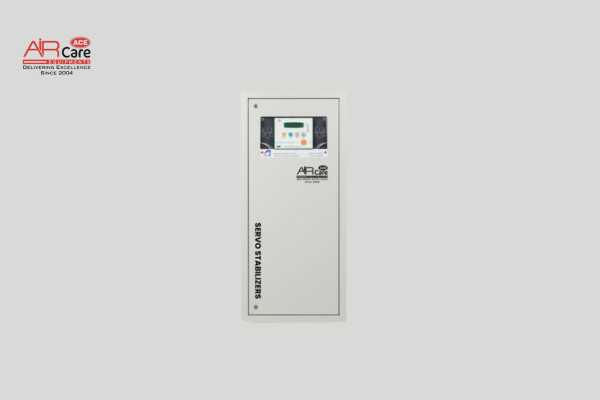
What Exactly is a Servo Voltage Stabiliser?
Before diving into the benefits, it is important to understand how this technology differs from standard relay-based stabilisers. A servo voltage stabilizer utilizes a high-speed servo motor to control a buck-boost transformer. It continuously monitors the incoming voltage and moves a carbon brush across a variable transformer to correct the output in real-time. This provides a near-perfect voltage output with a precision of ±1%, which is essential for the sophisticated electronics found in modern industrial machinery.
The Top 10 Benefits of Using a Servo Voltage Stabiliser
1. Superior Equipment Protection
The most immediate benefit is the physical protection of your assets. Industrial environments are notorious for "dirty power", a cocktail of spikes, sags, and surges caused by heavy machinery cycling on and off. A servo stabiliser acts as a high-speed gatekeeper. By neutralising these fluctuations before they reach your Industrial Air Compressor, it prevents catastrophic board failures and motor burnouts.
2. Significant Energy Efficiency & Cost Savings
Many businesses operate under the misconception that "more power is better." In reality, over-voltage causes equipment to run inefficiently, dissipating excess energy as heat. Conversely, under-voltage forces motors to draw higher current to maintain torque, which increases consumption. By maintaining the "sweet spot" of voltage, servo stabilisers ensure that you only pay for the energy your machines actually need to perform work.
3. Extended Equipment Life
The lifespan of a motor is directly tied to its operating temperature. Every time a motor experiences a voltage dip, it struggles, heats up, and the insulation on its windings degrades. Over months and years, this leads to premature failure. By providing a steady, clean power supply, you ensure that the equipment you purchased from your Air Compressor Supplier lasts for its full rated lifespan, often extending it by 25-30%.
4. Improved Productivity and Minimised Downtime
In a competitive market, downtime is the ultimate profit killer. If a voltage surge trips a breaker or damages a controller, your entire line stops. The time taken to diagnose the issue, source parts, and restart production can cost thousands of dollars per hour. Servo voltage stabilisers ensure that your workflow remains uninterrupted, regardless of what is happening on the external power grid.
5. Consistent Performance & Precision
Precision is the hallmark of modern manufacturing. Whether it’s a CNC machine cutting to a fraction of a millimetre or a medical imaging device, the internal logic of these machines depends on stable voltage. Fluctuations can cause "ghost errors" or slight variations in motor speed. A stabiliser ensures that your machinery operates at peak precision every single time.
6. Better Product Quality and Reduced Rejection Rates
If your production process involves heat, pressure, or high-speed rotation, even a 5% change in voltage can alter the end product. This is particularly true for plastic injection moulding or chemical processing. By maintaining uniform power, you eliminate the inconsistencies that lead to defective batches, thereby reducing your rejection rates and improving your brand’s reputation for quality.
7. Drastically Reduced Maintenance Costs
Frequent maintenance is often a symptom of poor power quality. If you find yourself replacing contactors, capacitors, or motors more often than scheduled, the culprit is likely your power supply. By stabilizing the voltage, you reduce the frequency of these "unforced errors," allowing your maintenance team to focus on proactive care rather than emergency repairs.
8. Enhanced Workplace Safety
Electrical fires are a major risk in industrial settings, often triggered by overheating due to voltage imbalances. By regulating the voltage, servo stabilisers prevent the excessive heat buildup that leads to short circuits. This creates a safer environment for your staff and protects the physical structure of your facility, including the integrity of tanks provided by your Pressure Vessel Manufacturer.
9. Protection of Data Integrity and IT Systems
Modern industrial equipment is rarely "dumb." Most are connected to SCADA systems, PLCs, and local servers for data logging. These IT components are incredibly sensitive to power fluctuations. A servo stabiliser ensures that your data remains uncorrupted and your automated logic systems don't experience the "reboots" or "hangs" that can occur during voltage instability.
10. Seamless Integration with Modern Energy Systems
As more industries move toward green energy, the integration of solar power and inverters has become common. However, switching between grid power and renewable sources can cause momentary voltage shifts. Servo stabilisers are designed to handle these transitions seamlessly, acting as a buffer that ensures your Industrial Air Compressor never "feels" the switch between energy sources.
The Synergy: Stabilisers, Compressors, and Pressure Vessels
When you work with a specialised Air Compressor Supplier, you are investing in a system designed for high-pressure output. However, that system is only as good as the power driving it.
Consider the relationship between the motor and the pressure vessel. The Pressure Vessel Manufacturer builds a tank to hold a specific PSI. To reach that PSI, the compressor motor must work against increasing resistance. If the voltage drops during the final stage of the compression cycle, the motor's torque drops, the current spikes, and the risk of a "stall-out" becomes real. A servo stabiliser ensures the motor has the "grunt" it needs to complete the cycle safely and efficiently.
Conclusion
In the high-stakes world of industrial manufacturing, hope is not a strategy. You cannot simply hope the power grid will remain stable. By choosing to install servo voltage stabilizers, you are taking a proactive step toward operational excellence.
At Air Care Equipments, we are committed to more than just sales; we are committed to the long-term success of your facility. From sourcing the right unit from an Air Compressor Supplier to ensuring your tanks from a Pressure Vessel Manufacturer are filled by a motor that is protected by stable power, we are your partners in productivity.
FAQs
Q1: How does a Servo Voltage Stabiliser differ from a standard Relay Stabiliser?
Standard stabilisers use relays to switch between different "taps" on a transformer, resulting in a "stepped" voltage correction that isn't very precise. A servo stabiliser uses a continuous motor-driven mechanism, providing a smooth, high-precision output that is far better for industrial-grade equipment.
Q2: Is it better to have one large stabiliser or several small ones?
This depends on your layout. For a facility with a primary Industrial Air Compressor and several smaller machines, a centralised heavy-duty servo stabiliser is often more cost-effective. However, if your machines are spread out across a large floor, individual stabilisers may prevent "voltage drops" that occur within long internal cable runs.
Q3: Can a Servo Stabiliser handle the high starting current of a compressor?
Yes. High-quality servo stabilisers are designed to handle momentary "inrush currents" (which can be 3-5 times the running current) without tripping, making them ideal for heavy inductive loads like air compressors.
Q4: How often does a Servo Stabiliser require maintenance?
Because they have moving parts (the servo motor and carbon brushes), they do require periodic inspection. However, with modern brushless motors and high-grade carbon, maintenance is usually limited to a simple annual check-up to ensure everything is clean and moving smoothly.
Recent Posts