

What is a Pressure Vessel?
At its core, a pressure vessel is a heavy-duty, enclosed container designed to hold gases or liquids at a pressure significantly different from ambient atmospheric pressure. In industrial environments, these units act as the primary energy buffer for compressed air systems. Because they are constantly subjected to high mechanical stress, they must be fabricated in accordance with stringent metallurgical standards and safety codes. A failure here isn't just an operational hiccup; it is a severe safety hazard, which is why precision engineering is non-negotiable.
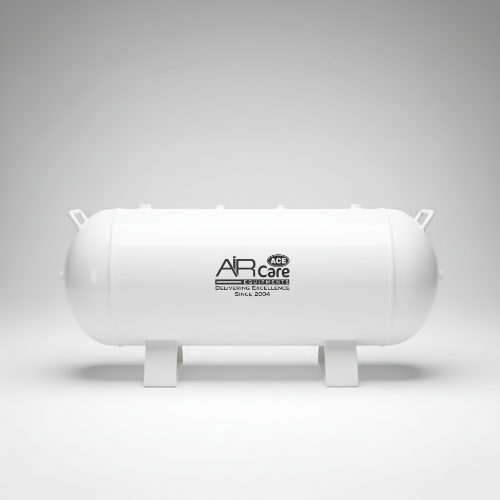

How It Works
When a compressor pushes out air, the flow is turbulent, pulsating, and hot. The moment this air enters the expansive volume of the pressure vessel, its velocity drops sharply. This sudden slowdown, combined with the cooling effect of the steel walls, forces suspended water and oil vapours to condense and fall to the bottom of the tank, where they can be drained away safely.
At the same time, the tank stores this treated air, smoothing out the aggressive pulsations. This means your downstream equipment receives a consistent, steady airflow. By acting as a buffer, the vessel also prevents the compressor motor from rapid short-cycling, saving significant energy and drastically extending the equipment's lifespan.
Understanding the Various Range of Pressure Vessels
We design and build systems for both horizontal and vertical layouts to match the exact spatial and operational realities of modern industrial floors. Whether you need a compact tank for a tight workshop or a massive installation for a heavy manufacturing plant, our design team ensures flawless integration. Our fabrication facility relies on advanced welding techniques and rigorous material testing to guarantee long-term durability. By strictly adhering to global codes, including PED (Pressure Equipment Directive) and ASME (American Society of Mechanical Engineers), we ensure that every unit we ship can handle extreme process demands with uncompromising safety margins.
Exploring the Different Types of Pressure Vessel
Choosing the right configuration is essential for maximising your floor space and operational flow. Here are the primary types of pressure vessel we offer:
-
1. Vertical Pressure Vessels: These are the most common choice for facilities with limited floor space. Their upright design allows for easy condensate drainage at the bottom.
-
2. Horizontal Pressure Vessels: Ideal for locations with height restrictions or for integration into mobile skid-mounted compressor packages.
-
3. High-Pressure Receivers: Specifically engineered for heavy-duty applications that require massive energy storage for sudden bursts of high demand.
What to Look for in a Pressure Vessel Manufacturer
When you team up with a dedicated Pressure Vessel Manufacturer, you aren't just ordering steel hardware; you're securing the reliability of your entire production line. We support clients across the industrial belt, delivering high-performance, fully compliant fabrication for manufacturing hubs throughout the NCR region, including Bhiwadi and Faridabad.
Customisation
We skip the one-size-fits-all approach. You get tailored systems engineered precisely for your specific CFM (Cubic Feet per Minute) demands and pressure ratings.
Quality and Compliance
Every unit undergoes exhaustive engineering calculations, non-destructive testing (NDT), hydrostatic checks, and strict surface-finish inspections to meet international export benchmarks.
Expert Support
From initial CAD sizing to final on-site commissioning, our specialists ensure your new tank integrates seamlessly into your existing pneumatic circuit.
